
Ramona Bathtub Damage From Extreme Temperature
That is why temperature damage bathtub Ramona CA is not a made-up niche topic. It is a real maintenance issue for homeowners living in a rural inland climate. FG Tub and Tile’s Ramona page already positions refinishing as a lower-disruption alternative to replacement and states that many projects can be completed in as little as one day. For Ramona homeowners whose tubs are starting to show roughness, fine cracking, dullness, or surface fatigue, understanding the climate factor can help explain why their tubs seem to be aging faster than those in milder parts of San Diego County.
Ramona homeowners deal with a bathroom stress pattern that most of coastal San Diego barely thinks about. In this backcountry part of the county, tubs and bathroom surfaces are not just fighting normal daily use. They also experience wide temperature swings throughout the year, including intense summer heat and cold-season nights that are far more severe than those experienced by homeowners near the coast. Repeated expansion and contraction, exposure to moisture, and surface fatigue can wear out a tub faster than many people expect.
This article explains what thermal cycling does to bathroom fixtures, which Ramona homes are most vulnerable, and when refinishing is the smart fix rather than waiting for the surface to deteriorate further.

Why Ramona Is Different From Coastal San Diego
Ramona sits in San Diego’s inland backcountry, not on a mild coastal strip. That means the temperature profile is simply more aggressive. Days can get very hot in summer, while winter nights can drop much lower than they do in coastal communities. Even without citing a specific number for every season, the basic local pattern is well established: Ramona experiences a much wider annual temperature range than neighborhoods near the ocean.
The local housing context makes that matter even more. The Ramona Community Plan describes a low-density rural community with a varied housing mix, rather than a uniform coastal-tract pattern. That means some homes have different insulation quality, different bathroom ventilation conditions, different slab or foundation relationships, and different exposure to overnight cold and daytime heat. In other words, the fixture environment is not just about weather. It is about how Ramona’s homes interact with that weather.
What Thermal Cycling Actually Does to a Bathtub
Thermal cycling is the repeated expansion and contraction that a material undergoes as temperatures rise and fall. In a bathroom, that process interacts with moisture, cleaning, mineral deposits, and daily use. Over time, a tub surface can show signs of fatigue from this constant stress. The damage may not happen all at once. Instead, it often appears as slow, accumulating wear: loss of gloss, fine crazing, roughness, weakened caulk lines, more visible stains, and a finish that seems to give up earlier than expected.
In Ramona, this matters because the tub is not exposed to one climate stressor. It may experience hot summer bathroom conditions, cooler overnight temperatures, seasonal cold snaps, and exposure to water or minerals at the same time. A surface that already has tiny weaknesses can gradually get worse under those conditions.
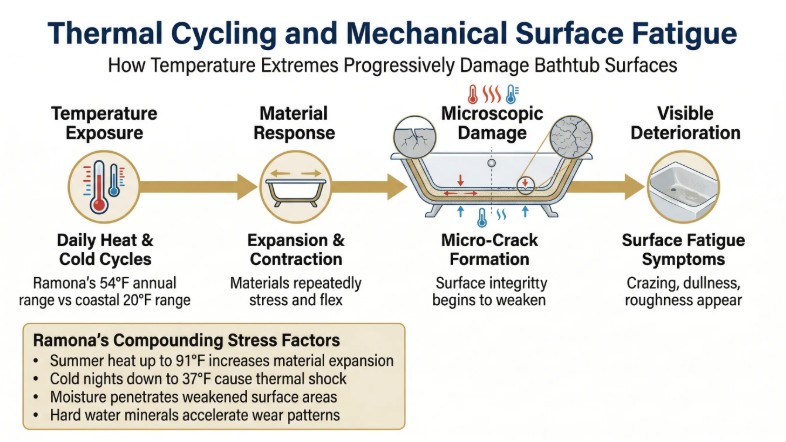
The Main Fixture Stressors Ramona Homeowners Face
| Stress factor | What it does | Why it matters in Ramona |
|---|---|---|
| Summer heat | Increases surface expansion and overall material stress | Ramona’s inland location creates hotter conditions than coastal San Diego |
| Cold-season nights | Contributes to contraction and adds temperature swing | Backcountry homes experience colder nights than coastal homes |
| Moisture exposure | Works into existing surface weaknesses over time | Bathrooms trap humidity and repeated wet-dry cycles |
| Mineral-heavy water | Builds up residue and can worsen roughness and cleaning stress | Local water context and rural-property conditions make this relevant in Ramona |
| Aggressive cleaning after wear begins | Can accelerate finish loss and surface dulling | Homeowners often scrub harder when the tub starts looking permanently dirty |
Which Ramona Homes Are Most Vulnerable?
Not every bathroom in Ramona will wear the same way. The homes most likely to show faster temperature-related deterioration usually share one or more of the following conditions: they are older, less evenly insulated, more exposed to backcountry temperature fluctuations, or built with more economical fixtures that were never designed to withstand decades of stress.
That includes several property types specifically relevant to Ramona:
- Older rural homes, where the original bathroom materials have already been through many years of seasonal cycling.
- Manufactured homes, where thinner assemblies may react more visibly to outdoor temperature patterns.
- Post-fire rebuild homes where builder-grade fixtures installed 15 to 20 years ago may now be reaching a maintenance tipping point.
- Acreage and backcountry properties where bathrooms may sit in homes with different exposure and climate behavior than dense suburban neighborhoods.
Cal OES notes the scale of the Cedar Fire’s impact on Ramona and the surrounding region, with thousands of structures destroyed and many homes rebuilt afterward. That rebuild history matters because a large group of Ramona homes is now old enough to be facing the first serious wave of bathroom surface decline.
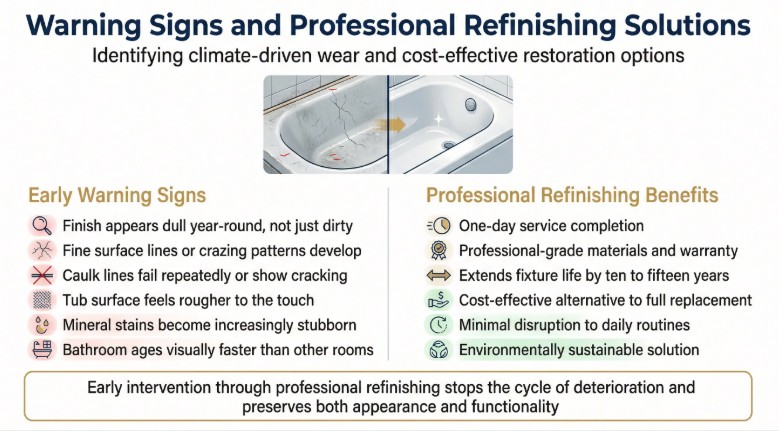
Warning Signs the Climate Is Catching Up to Your Tub
- The finish looks dull all year, not just dirty.
- You notice fine surface lines or a “tired” texture.
- The caulk line or surrounding transitions seem to fail repeatedly.
- The tub feels rougher than it used to, especially on the floor or along the walls.
- Mineral staining seems harder to remove than before.
- The bathroom ages visually faster than the rest of the room.
None of these signs alone proves freeze-thaw, or that temperature range is the only culprit. But in Ramona, they often appear as part of a broader pattern of deterioration shaped by climate, water, and time.
How Water Conditions Compound the Problem
Ramona Municipal Water District publishes local water-quality information and annual reports, reinforcing that homeowners here live with a real local water profile, not a generic county average. When mineral residue builds up on a surface that is already experiencing expansion and contraction stress, the result can be a more demanding maintenance cycle. Homeowners start scrubbing harder. The surface gets rougher. The finish holds more residue. And the tub begins to look older than its actual structural condition would suggest.
This is one reason Ramona homeowners can feel confused by what they see. The tub may not be “broken” in the way a leak is broken, but it is clearly wearing out faster than expected. In many cases, the explanation is cumulative stress rather than one dramatic failure.
Why Refinishing Makes Sense Before the Surface Gets Worse
Once climate-related wear starts to show, many homeowners assume they should wait until the tub is much worse before doing anything. That is usually not the best move. A tub that is structurally sound but visibly fatigued is often a strong candidate for refinishing. Restoring the surface early can stop the cycle of frustration where the homeowner keeps cleaning harder while the tub keeps looking worse.
FG Tub and Tile frames refinishing as a practical alternative to replacement, which fits Ramona well. If the problem is surface fatigue, dullness, chips, roughness, or visible age—not structural failure—refinishing can restore appearance and usability without turning the bathroom into a demolition project. That is particularly attractive in Ramona, where homeowners often prefer focused maintenance over an oversized renovation scope.
Why This Matters More in Ramona Than in Other San Diego Markets
Plenty of San Diego homeowners deal with worn tubs. What makes Ramona different is the combination of inland heat, colder nights, rural property conditions, mineral-related wear, and a housing stock that includes both older homes and rebuild-era properties now hitting a mature maintenance stage. Coastal homeowners may face one or two of those issues. Ramona homeowners often face several at once.
That is why this article is more than a climate curiosity. It is a real explanation for why backcountry tubs can seem to wear out faster than expected, even when the homeowner is not doing anything “wrong.” The environment itself is part of the story.
How to Respond If Your Tub Shows These Signs
The smartest response is not panic. It is an assessment. If the tub is still structurally sound, do not assume full replacement is your only option. Instead, ask whether the visible problems are mostly related to the finish. If they are, refinishing may be the cleanest and most cost-effective way to reset the surface and improve the whole bathroom.
That is especially true if you have already reached the point where regular cleaning no longer restores the appearance, or if the tub seems to be aging faster than the rest of the room. In Ramona, that often points toward climate-compounded surface wear rather than a fixture that needs to be torn out.
Final Takeaway
Ramona’s wide temperature range is one of the most overlooked reasons bathroom fixtures wear out faster in San Diego’s backcountry. Heat, cold, moisture, and mineral exposure create a repeated stress cycle that can leave tubs dull, rough, stained, and prematurely aged. Homeowners who understand that pattern are in a better position to act before the surface gets worse.
If your tub is structurally sound but clearly worn out from years of backcountry use, professional refinishing is often the smartest next step. It restores the finish, avoids unnecessary demolition, and fits the practical maintenance mindset that makes sense in Ramona. A direct quote is the best way to find out whether your tub is ready for restoration.
FAQs
Can Ramona’s temperature swings really damage a bathtub?
Yes. Repeated heat and cold can contribute to surface fatigue over time, especially when combined with moisture, mineral buildup, and daily use.
What does thermal cycling damage look like in a bathroom?
It can show up as dullness, roughness, fine surface crazing, repeated caulk-line issues, and finishes that seem to age faster than expected.
Which Ramona homes are most vulnerable to temperature-related bathtub wear?
Older rural homes, manufactured homes, and rebuild-era houses with builder-grade fixtures may be especially vulnerable.
Does hard water make temperature-related wear worse?
It can. Mineral buildup adds another layer of stress by increasing surface residue, roughness, and cleaning intensity.
Should I replace the tub if I think climate damage is part of the problem?
Not necessarily. If the tub is structurally sound and the main issues are surface-related, refinishing is often a more practical solution.
continue reading
Related Posts
Bathtub Refinishing Ramona A Neighborhood-by-Neighborhood Guide for Village Homes, Country
Guest House Bathtub Refinishing in Ramona Keep Secondary Bathrooms Guest-Ready
Bathtub Refinishing in Ramona Rebuild Homes This is why post