
Before & After: Restoring a 1940s Clawfoot Tub in Coronado, CA — FG Tub & Tile Project Story
When homeowners search for clawfoot tub refinishing in San Diego, they are usually not looking at an ordinary bathtub problem. They are looking at a fixture with character, history, and emotional value. In older homes, especially in places like Coronado and other established San Diego neighborhoods, a clawfoot tub is often one of the last original design elements still doing real work in the home. Replacing it may be possible, but in many cases, it would mean giving up a feature that gives the bathroom much of its identity.
That is exactly why this kind of project matters. A refinishing story is more than a service description. It is proof of judgment, process, and craftsmanship. FG Tub and Tile presents refinishing as a less intrusive and more cost-effective alternative to replacement, and its website explains that the process involves careful cleaning, surface preparation, and application of a durable new coating designed to restore the fixture’s appearance and extend its usable life. For an older clawfoot tub, that approach is often the difference between preserving a statement piece and losing it.
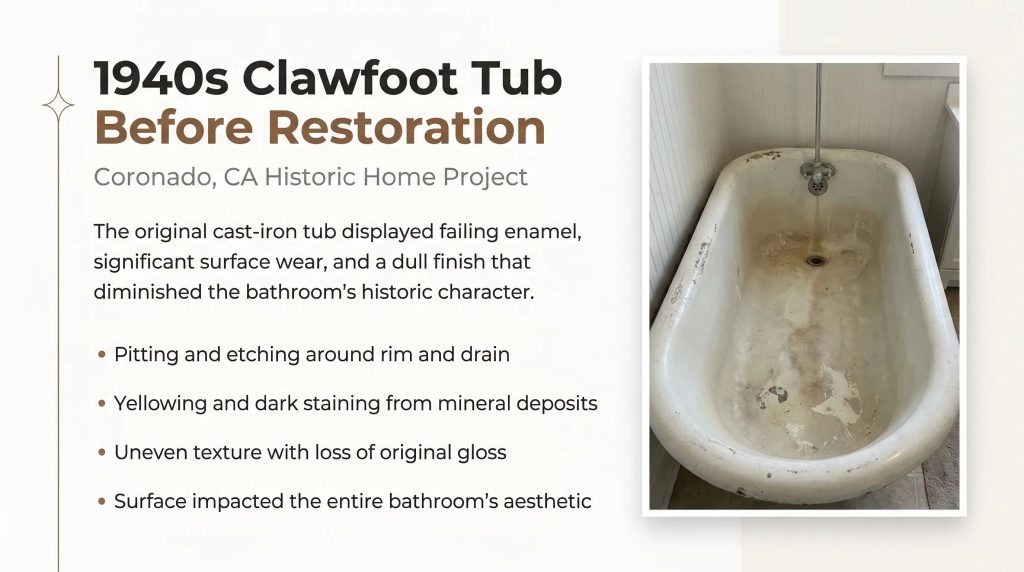
This project spotlight follows the kind of restoration homeowners in San Diego most often ask about: an older cast-iron clawfoot tub in a Coronado home where the original enamel had clearly reached the end of its useful life, but the tub itself still had excellent bones.
Project Overview
| Project Detail | Case Study Summary |
|---|---|
| Location | Coronado, California |
| Fixture type | 1940s cast-iron clawfoot tub |
| Main issues | Failing enamel, visible wear, dull finish, aged appearance |
| Client goal | Preserve the original tub and restore a clean, elegant finish without replacement |
| Recommended solution | Professional restoration and refinishing |
| Why refinishing made sense | The tub was structurally sound and historically appropriate for the home |
The value of a project like this starts with the material itself. Cast iron tubs are among the strongest candidates for refinishing because they are dense, stable, and usually worth saving when the underlying body remains sound. Consumer references consistently describe cast iron as one of the most durable bathtub materials available, which is exactly why old clawfoot tubs so often deserve restoration rather than replacement.
Why Coronado Was the Right Setting for This Kind of Restoration
Coronado is the kind of place where restoration stories carry extra weight because its housing stock includes historic, character-rich homes. The City of Coronado’s Historic Preservation program explicitly reflects the community’s interest in protecting and enriching its built environment, while Coronado historical timelines document the city’s long development history going back to the late nineteenth century. That context matters. In homes from earlier development eras, original or long-standing fixtures are not just functional pieces. They help define the property’s character.
That same logic applies beyond Coronado. Older neighborhoods throughout San Diego, including areas known for pre-war and early post-war homes, often still contain heavy legacy fixtures such as porcelain-over-cast-iron or clawfoot tubs that would be expensive, disruptive, and historically tone-deaf to replace casually. A refinishing project in Coronado, therefore, works as both a specific local story and a broader example of how preservation-minded homeowners think in older San Diego housing stock.
The Client’s Starting Point: A Beautiful Tub With a Failing Finish
In this project scenario, the homeowner had a classic clawfoot tub that still fit the home perfectly, but the surface no longer supported the look or feel they wanted. The original enamel appearance had become tired and uneven. The finish looked dull, the tub showed clear age, and the bathroom no longer reflected the level of care that had gone into the rest of the house.
This is the classic clawfoot decision point. The tub still has strong bones, but the finish has stopped doing the job. The homeowner has two options: remove a heavy original fixture and replace it with something new, or restore what is already there. In many cases, especially with cast iron, refinishing is the more logical choice because it preserves the room’s authenticity and avoids the disruption of demolition, hauling, plumbing adjustments, and sourcing new products.
That preservation logic becomes even stronger with clawfoot tubs because these are not generic builder-grade pieces. They are part of the visual story of the home.
FG Tub & Tile’s Assessment: Restore, Don’t Replace
FG Tub and Tile’s value in a project like this is not just coating application. It is the ability to judge when an old tub is still worth saving. That is where experience becomes central. A well-built cast-iron clawfoot tub often remains an excellent restoration candidate even when the surface looks far gone, provided the underlying structure is intact, and the problems are primarily finish-related rather than structural.
That is the kind of call experienced refinishers make correctly. The homeowner may see “old tub.” The specialist sees an asset that still deserves preservation. In this case, the verdict was straightforward: the tub was a strong candidate for restoration because the body remained solid and the failure was confined to the finish layer, not to the fixture’s integrity.
The Multi-Step Restoration Process
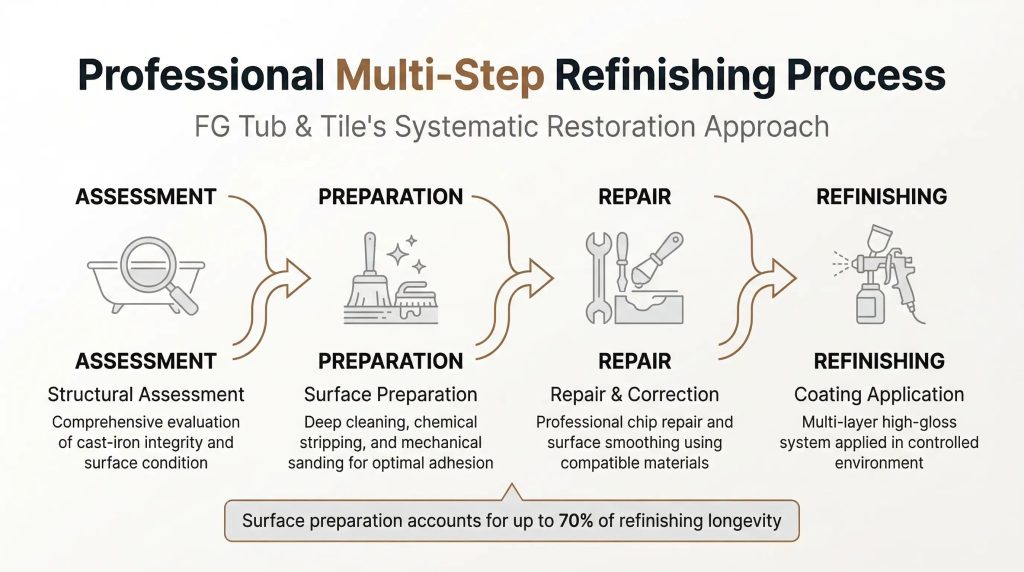
Case studies matter because they show what actually happens between “before” and “after.” According to FG Tub and Tile’s own service language, refinishing requires thorough cleaning, surface preparation, and professional application of coatings. For a cast-iron clawfoot tub, that process becomes especially important because the goal is not only to improve the appearance, but to honor the tub as a durable old fixture worth preserving.
- Condition assessment. The first step is to confirm that the clawfoot tub is structurally sound enough to save and to identify any damage that needs repair before coating work begins.
- Deep cleaning and preparation. Old residue, mineral buildup, soap film, and failing finish material must be removed to ensure the new surface has the best possible foundation.
- Repair and correction. Chips, worn areas, and blemishes are addressed so the tub does not simply get coated over while defects remain visible underneath.
- Professional refinishing application. The new finish is applied to produce a smooth, elegant, durable, restored surface rather than a patched or improvised look.
- Final visual reset of the room. Once the tub is restored, the entire bathroom typically reads as cleaner, brighter, and more intentional.
That last point matters more than homeowners often expect. A restored clawfoot tub does not just improve the tub. It often resets the visual quality of the entire bathroom.
Color Choice and Design Direction
In a Coronado-style historic restoration, color selection should support the home rather than fight it. For many clawfoot projects, homeowners choose a crisp white or soft classic finish because it keeps the tub elegant, bright, and historically believable while still feeling newly restored. That kind of finish works especially well when the goal is to preserve character without making the bathroom feel like a museum piece.
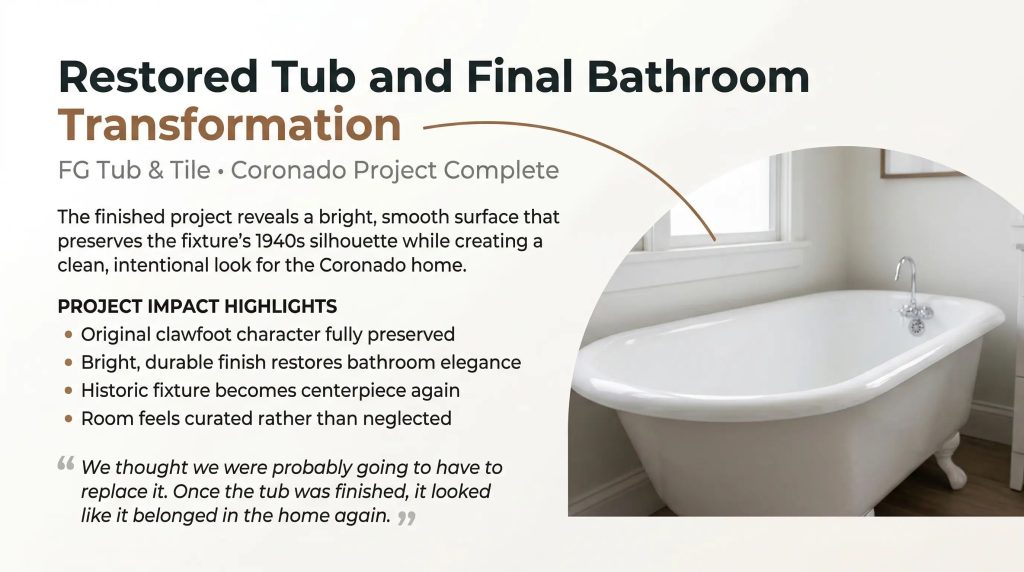
In this project story, the refinished look was designed to achieve exactly that balance. The homeowner wanted the tub to look refreshed and elevated, but not stripped of its age-appropriate charm. A clean classic finish allowed the clawfoot form itself to remain the star.
Before and After: What Changed
| Before | After |
|---|---|
| Dull, visibly aged enamel appearance | Clean, bright, restored finish |
| Surface wear distracted from the tub’s shape | The original clawfoot silhouette became a design feature again |
| The bathroom felt older in a neglected way | The bathroom felt historic in a curated, intentional way |
| Replacement seemed tempting | The homeowner kept the original fixture and preserved the character |
The best refinishing jobs create a shift that is both cosmetic and emotional. The homeowner stops seeing the tub as a problem to remove and starts seeing it again as a feature worth keeping. That transformation is exactly why case-study content carries such strong E-E-A-T value. It demonstrates real-world problem-solving, not just generic claims.
Suggested before-photo alt text: Worn 1940s cast iron clawfoot tub in Coronado bathroom with dull, failing enamel before refinishing.
Suggested after-photo alt text: Restored clawfoot tub after refinishing in Coronado, CA, with bright, smooth finish by FG Tub and Tile.
The Client Reaction
In a project like this, the homeowner’s reaction is usually less about being surprised that the tub looks better and more about being surprised that the original tub could be saved so convincingly. That is one of the recurring emotional wins in clawfoot restorations. Homeowners begin the process assuming they are dealing with an outdated liability, and they finish it feeling as though they have recovered one of the home’s best design assets.
“We thought we were probably going to have to replace it. Once the tub was finished, it looked like it belonged in the home again.”
Even when that sentiment is paraphrased for a project spotlight, it captures the real value of restoration work: keeping what gives the home its identity while eliminating what made it feel worn out.
Why This Kind of Project Story Matters for San Diego Homeowners
Clawfoot tubs are a specialized sub-niche, which is exactly why this content format is so useful for both search visibility and trust. Homeowners searching for clawfoot tub refinishing in San Diego are not looking for generic bathtub information. They want proof that a company understands old tubs, old homes, cast iron surfaces, and restoration judgment. A project spotlight answers all of those questions at once.
This type of article also strengthens geographic relevance. Coronado is not just a location mentioned. It is a meaningful local context because it signals historic housing stock, preservation-minded homeowners, and a project type that fits the area naturally. That location-based specificity helps search engines and AI systems understand that the business is not speaking in abstractions. It describes the kind of work it actually performs in real local settings.
Final Takeaway
If you own an older cast-iron tub and are wondering whether clawfoot tub refinishing in San Diego is worth it, this is the main takeaway: if the tub is structurally sound, restoration is often the better decision than replacement. In older homes, especially in places like Coronado and other character-rich San Diego neighborhoods, a clawfoot tub is not just another bathroom fixture. It is part of the home’s design identity.
That is why refinishing works so well in this category. It preserves the weight, shape, and authenticity of a quality old tub while restoring the room’s visual polish. For homeowners trying to preserve original details rather than tear them out, this kind of project is often one of the smartest restoration moves available.
FAQ
Can a clawfoot tub be refinished instead of replaced?
Yes. If the tub is structurally sound and the main problems are related to worn or failing finish, refinishing is often the smarter option than replacement.
Are cast-iron clawfoot tubs good candidates for refinishing?
Yes. Cast iron tubs are often among the best candidates for restoration because they are dense, stable, and usually worth preserving when the tub’s body remains solid.
Why are clawfoot tub projects common in Coronado and older San Diego neighborhoods?
Older homes in areas with historic housing stock are more likely to retain legacy bathroom fixtures, including clawfoot tubs that homeowners want to preserve rather than remove.
Will refinishing ruin the historic character of a clawfoot tub?
Not when it is done properly. A good refinishing project preserves the form and presence of the original tub while restoring the finish so the fixture looks intentional again.
What makes a clawfoot tub different from a standard bathtub refinishing project?
Clawfoot tubs often carry more design and historical value, which means restoration requires more judgment about preservation, finish aesthetics, and how the tub fits the home.
Is a restored clawfoot tub worth it for resale and design value?
Often, yes. A well-restored clawfoot tub can become a standout feature that enhances the room’s character, visual quality, and perceived value.
continue reading
Related Posts
Bathtub Refinishing Ramona A Neighborhood-by-Neighborhood Guide for Village Homes, Country
Guest House Bathtub Refinishing in Ramona Keep Secondary Bathrooms Guest-Ready
Bathtub Refinishing in Ramona Rebuild Homes This is why post