
Before & After: Turning a 1963 La Mesa Bungalow’s Avocado Tub Back to White
One of the most recognizable bathroom problems in older La Mesa homes is the original colored tub that has crossed the line from vintage to visually exhausting. It is not just green, gold, or pink. It is green, with years of mineral deposits, cleaning wear, surface dullness, and a texture that makes the whole bathroom feel older than it really is. That is why a story like this matters. A 1960s bathtub refinishing project: avocado bathtub restoration La Mesa is not just about changing color. It is about recognizing the difference between a tub that looks worn out and one that is still worth saving.
This case-study-style article follows a common East County restoration scenario Fidel has encountered many times: a 1963 La Mesa bungalow, an original avocado-colored tub, and a homeowner who wants the bathroom to feel clean and current again without launching a full remodel. The details here are presented as a representative local restoration story built around real fixture conditions common in older La Mesa homes. Where exact homeowner quotes or project photos would normally appear, placeholders are included unless those assets are later supplied.
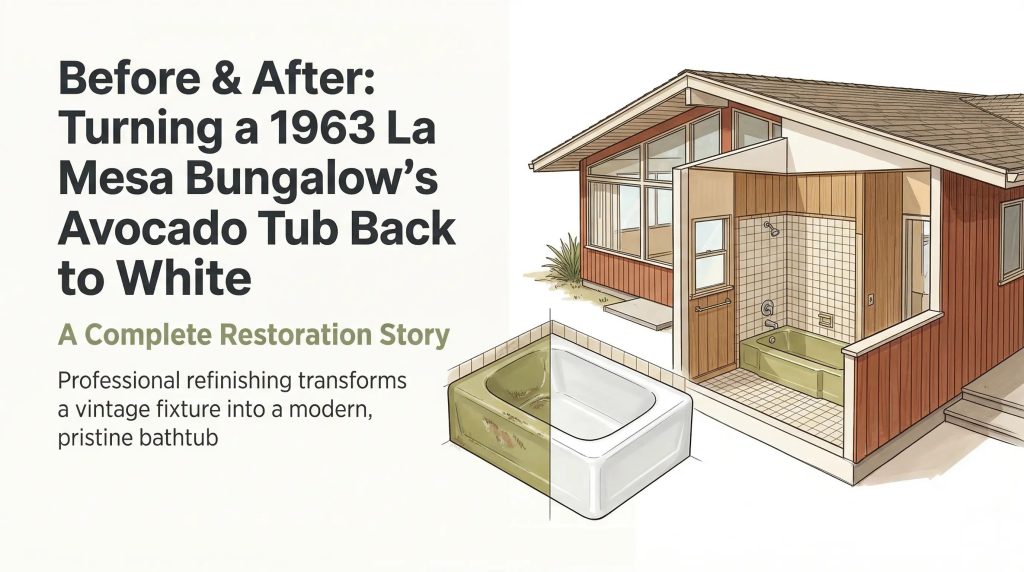
Project Snapshot
| Project Detail | Description |
|---|---|
| Home type | 1963 La Mesa bungalow |
| Neighborhood context | Established La Mesa residential area with older housing stock |
| Original tub condition | Avocado green finish with years of dullness, staining, and surface wear |
| Homeowner goal | Restore the bathroom’s appearance by refinishing the tub to white |
| Why refinishing made sense | The fixture was still structurally sound, and the homeowner wanted to avoid a full bathroom remodel |
Why This Kind of Job Is So Common in La Mesa
La Mesa has the kind of housing stock that allows original bathroom fixtures to survive for decades. The city’s history and housing materials reflect a longstanding residential identity with mature neighborhoods rather than only recent tract construction. The Village of La Mesa is also an official place anchor tied to older residential blocks and established homes. In practical terms, that means homeowners here are far more likely to inherit a bathroom with original fixtures and period colors than homeowners in a newer market.
That older-housing context is one reason this tub-restoration story feels so specific to La Mesa. It is not unusual for a bungalow or mid-century home to still have its original tub. What changes over time is the surface condition. The tub may be structurally solid, but years of hard use and aggressive cleaning can make it look permanently dirty or irreparably dated.
The Homeowner’s Problem
In this representative La Mesa project, the homeowner’s frustration was not that the tub had stopped working. It was that the bathroom no longer felt clean, no matter how much effort went into maintaining it. The avocado finish made the room feel visually heavy. The surface had lost its smooth look. The tub floor and walls showed the kind of dullness that makes soap residue cling faster and makes the whole bathroom read as “old.”
This pattern is well supported by what happens to older porcelain surfaces over time. Ferguson’s guidance on old porcelain tubs notes that harsh cleaners, steel wool, scouring powders, and acidic products can damage the finish, while hard water standing on the surface can leave marks or etch it. In other words, the homeowner was not imagining the decline. The tub had likely been carrying visible surface fatigue for years.
Fidel’s Assessment: Ugly Is Not the Same as Unsalvageable
One of the biggest value points in a restoration project like this is the initial assessment. Fidel’s East County perspective is that many older La Mesa tubs look worse than they really are. The color may be dated, the finish may be worn, and the tub may feel impossible to clean, but that does not automatically mean replacement is necessary. The real question is whether the tub body is still solid and whether the surface can be prepared properly for a durable new finish.
That distinction matters in a 1960s bungalow because replacement often creates a much larger project than homeowners intend. Once demolition starts, the tub is no longer the only issue. Surrounding finishes, plumbing access, wall repair, and timeline expansion can follow quickly. If the original tub is still structurally sound, refinishing often becomes the smarter path.
What the Surface Usually Looks Like on a Tub Like This
On an older avocado-colored tub in La Mesa, Fidel typically looks for a cluster of familiar problems rather than one single dramatic failure. The finish may have been dulled by decades of abrasive cleaning. Mineral marks may have accumulated in areas where water sits most often. The original color may show unevenly through wear zones. The tub may feel slightly rough rather than slick, which causes it to collect soap scum more quickly and look dirty even after being freshly cleaned.
That combination is what makes original tubs feel so discouraging to homeowners. It is not the color alone. It is the sense that the tub has become impossible to restore. In many cases, though, the problem is still at the finish level. That is exactly where refinishing can create a dramatic turnaround.
The Restoration Goal: From Vintage Burden to Clean White Surface
For this La Mesa bungalow scenario, the homeowner’s goal was clear: keep the bathtub, lose the avocado, and make the bathroom feel brighter. White was the obvious choice because it immediately neutralizes the vintage color problem and works with almost any broader bathroom update plan. It also tends to support resale, staging, and everyday visual cleanliness better than a strong original color if the homeowner is not specifically preserving a mid-century design statement.

This is one reason avocado-to-white refinishing is such a strong topic in the East County. It combines the local reality of older fixtures with the practical desire to modernize without incurring the cost of a full replacement.
How the Refinishing Process Solves the Real Problem
A professional refinishing job is not just a color cover-up. It is a restoration process. For a project like this, the important work happens in the preparation phase. The surface must be evaluated, thoroughly cleaned, and prepared so the new coating can bond properly and produce a finish that looks clean rather than cosmetically forced. In an older tub, this may also involve addressing roughness, small chips, etched areas, or lingering residue from years of use.
What makes this type of restoration especially valuable is that it changes both appearance and usability. A smooth, properly refinished tub is easier to clean, feels newer to the touch, and doesn’t visually drag the entire bathroom backward. The homeowner does not just get a new color. They get a room that feels more livable again.
The most satisfying part of a project like this is that the homeowner often assumes the tub is beyond saving right up until the finished result proves otherwise.
Why Refinishing Made More Sense Than Replacement
General cost data from Angi show that refinishing is typically far less expensive than replacement, often costing hundreds rather than the thousands associated with a full tub replacement. In a La Mesa bungalow, that difference matters even more because the tub is usually part of an older bathroom that was never designed for quick, low-disruption fixture swaps.
That is what makes this kind of case study powerful. The homeowner was not simply saving money for the sake of saving money. They were choosing the solution that solved the actual problem. The tub looked old, not structurally finished. Refinishing corrected the look without turning a manageable update into a construction project.
The Result: What Changes in the Room After the Refinish
When an avocado tub is refinished to white, the visual effect is larger than many homeowners expect. The bathroom feels brighter immediately. The walls and tile read differently because the tub no longer dominates the palette. The room looks cleaner in daylight and artificial light. Even older surrounding finishes can look more intentional once the tub stops acting like a visual anchor to another era.
That is why these projects are so useful in La Mesa homes. They preserve the original fixture while changing the bathroom’s emotional reading. Instead of “old bathroom with a green tub,” the room becomes “an older bathroom that has been cared for.” That is a major shift for homeowners living with the space every day and for buyers evaluating the home later if resale becomes part of the picture.
Before-and-after asset placeholders
Before photo alt text placeholder: Original avocado green bathtub in a 1963 La Mesa bungalow with visible dullness and wear.
After photo alt text placeholder: Same La Mesa bungalow bathtub refinished to bright white with a smooth restored finish.
Homeowner quote placeholder: “[TESTIMONIAL PLACEHOLDER: homeowner reaction to seeing the tub restored to white.]”
Why This Story Builds Trust for La Mesa Homeowners
Case studies work because they make the problem real. A generic article about refinishing cannot convey the same level of practical understanding as a local story about a 1963 bungalow, an avocado tub, and a homeowner tired of decades of wear. This is the kind of project that reflects actual La Mesa housing conditions, not just broad bathtub marketing language.
For East County homeowners, that matters. It shows that the contractor understands local housing eras, the realities of older fixtures, and the difference between what looks bad and what is truly beyond repair.
Frequently Asked Questions About 1960s Tub Refinishing in La Mesa
Can a 1960s avocado-colored tub really be refinished to white?
Yes, if the tub is structurally sound and still a good refinishing candidate. A professional restoration process can update the finish without replacing the tub.
Why do old tubs often look permanently dirty?
Older porcelain finishes can become etched, scratched, dulled, and stain-prone over time, especially when harsh cleaners and hard water have worn the surface.
Is refinishing usually cheaper than replacing an old tub?
Yes. General cost benchmarks show refinishing is typically much less expensive than replacement, especially when the existing tub can still be saved.
Does this kind of project make sense for resale, too?
Often, yes. A clean, white refinished tub typically improves the bathroom’s overall presentation and makes it feel less dated.
Do you need a full remodel to fix an outdated colored tub?
No. If the tub is structurally sound, refinishing is often the most efficient way to update the space without launching a full renovation.

A Local Restoration Story That Makes Sense in Older La Mesa Homes
The reason this kind of job resonates so strongly in La Mesa is simple: the city still has the homes, bathrooms, and original tubs that make it relevant. A 1963 bungalow with an avocado fixture is not an odd outlier here. It is part of the local housing story. And that means the solution has to fit that reality too.
If your La Mesa home has an original tub that looks dated, dull, stained, or impossible to clean, FG Tub and Tile can help you determine whether it is a good candidate for refinishing. Fidel’s experience with older East County tubs makes the difference between guessing and getting a real answer.
Visit FG Tub and Tile’s La Mesa page to learn more about local tub refinishing options.
continue reading
Related Posts
Bathtub Refinishing Ramona A Neighborhood-by-Neighborhood Guide for Village Homes, Country
Guest House Bathtub Refinishing in Ramona Keep Secondary Bathrooms Guest-Ready
Bathtub Refinishing in Ramona Rebuild Homes This is why post