
Why Pauma Valley Bathtubs Age Differently
What Agricultural Water, Groundwater, and Rural Use Patterns Do to Bathroom Surfaces
In Pauma Valley, CA, not every bathtub problem starts with age alone. Sometimes the surface damage homeowners see is really the result of the local water environment. When a tub develops roughness, stubborn stains, dullness, etched-looking patches, or a surface that never seems fully clean, no matter how much scrubbing, the problem may be due to hard-water bathtub damage rather than ordinary wear.
That matters in a rural community like Pauma Valley because the water story here is different from that in a dense coastal suburb. The local environment is shaped by agricultural land use, groundwater dynamics, basin management challenges, and rural infrastructure patterns. Those conditions can influence how mineral residue forms, how surfaces stain, and how quickly a bathtub starts to look permanently tired, even when the homeowner is cleaning it regularly.
For many homeowners, this is frustrating because the tub looks dirty, but the real issue is not dirt. It is a surface change. Once that change reaches a certain point, better cleaning products do not solve it. Understanding that distinction is the first step toward deciding whether the tub needs maintenance changes, a protective strategy, or full refinishing.

Why Pauma Valley Has a Different Bathroom-Surface Story
Pauma Valley is part of a rural North County environment connected to agricultural land use, the San Luis Rey watershed landscape, and local groundwater systems. Regional entities such as the Upper San Luis Rey Groundwater Management Association exist precisely because water resources in this region are an important and active issue. That does not mean every home has the same water conditions, but it does support a broader point: Pauma Valley is not a one-size-fits-all municipal water setting.
In areas where mineral-rich water or hard-water exposure is part of the everyday background, bathroom surfaces often tell the story first. Bathtubs are among the most visible places where homeowners notice the effects. The tub is exposed repeatedly, it dries unevenly, soap residue interacts with mineral content, and over time, the finish can take on a dull, chalky, or roughened appearance that ordinary cleaning cannot reverse.
What Hard Water Bathtub Damage Usually Looks Like
One reason hard-water damage is so often misunderstood is that it does not always announce itself dramatically at first. It can begin as a faint haze or a loss of shine. Then the symptoms become more obvious. In a tub, especially one used daily, homeowners may start noticing:
- A dull or chalky look that comes back quickly after cleaning
- Mineral staining that seems bonded to the surface
- Roughness under the hand or feet
- Soap scum that sticks more aggressively than before
- Discoloration that appears permanent
- An overall sense that the tub is aging faster than expected
These symptoms matter because they often indicate a surface problem, not just a housekeeping problem. The longer mineral buildup and repeated exposure persist, the more likely the finish is to stop responding to routine care.
Why Rural Water Conditions Can Change How a Tub Ages
In suburban content, hard water is usually discussed in generic terms. In Pauma Valley, the topic warrants deeper exploration. This is a community shaped by a mix of rural infrastructure, agricultural surroundings, and water-management realities that are part of the broader Pala/Pauma region. When water chemistry and mineral exposure are part of the environment, household fixtures can reflect that over long periods of time.
Bathtubs are especially vulnerable because they combine repeated water contact with a surface that homeowners expect to remain smooth, bright, and easy to clean. When minerals repeatedly dry on that surface, especially if the finish has already started to weaken, the tub can shift from “a little stained” to “permanently altered” surprisingly fast.
Why Scrubbing Harder Often Makes the Problem Worse
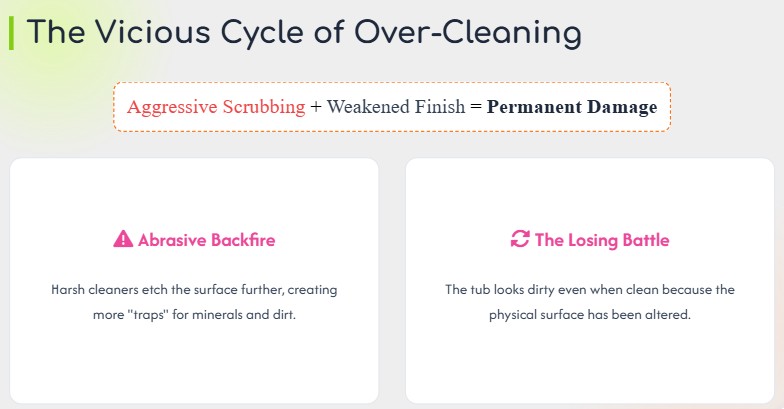
One of the most common patterns in water-damaged tubs is that homeowners start cleaning more aggressively as the tub looks worse and worse. That response is understandable, but it can backfire. Once minerals have dulled the finish or created a roughened layer, abrasive scrubbing often accelerates the problem rather than solving it.
The reason is simple: a weakened or etched surface traps more residue. The more residue it traps, the dirtier it looks. The dirtier it looks, the more aggressively the homeowner scrubs. Eventually, the finish can lose even more of its original smoothness, making the bathtub even harder to keep clean.
That cycle is one reason some homeowners feel like they are losing a battle with the tub. They are not imagining it. The surface itself may have changed enough that cleaning can no longer restore the look they want.
A Practical Symptom Guide for Pauma Valley Homeowners
| Symptom | What It May Mean | Why It Matters |
|---|---|---|
| White or chalky residue | Mineral buildup | Can signal repeated hard-water drying on the surface |
| Staining that will not clean off | Etching or bonded mineral staining | May indicate the surface is no longer intact enough for ordinary cleaning |
| Rough texture | Finish wear or mineral abrasion | Encourages soap scum and residue to stick faster |
| Dull or gray-looking finish | Oxidation, wear, or etched coating damage | Makes the tub look permanently old even when it is clean |
| Constant soap-scum return | Surface roughness combined with mineral conditions | Suggests the finish is trapping buildup |
Why This Matters for Agricultural and Rural Properties
Pauma Valley includes homes influenced by orchards, agricultural land use, and rural property patterns. Some homes are near the Pauma Valley Country Club, while others are farther into rural stretches linked to the broader Highway 76 corridor. That mix matters because water patterns, usage habits, and fixture wear can vary more widely across rural communities than in dense, uniform neighborhoods.
Even when water conditions differ from one property to another, the broad lesson stays the same: the environment can shape how a bathtub ages. In Pauma Valley, that means some tubs may show mineral-related wear in ways that homeowners from purely urban settings would not expect.
When the Problem Stops Being a Cleaning Issue
There is a point at which a bathtub stops needing a better cleaner and starts needing a surface restoration. That transition is important. If the tub still looks bad immediately after careful cleaning, the finish feels rough, or stains appear embedded in the surface, the issue may already be beyond routine maintenance.
This is where refinishing becomes relevant. Refinishing is not a substitute for good cleaning. It is a solution when the original finish has been altered enough that cleaning alone cannot restore the tub. In a Pauma Valley home, that may happen because of years of mineral exposure, repeated residue buildup, and damage from overcompensating with harsh cleaners.
What Homeowners Can Do After Refinishing
One of the strongest trust signals in an article like this is practical advice. Homeowners should know that refinishing can restore the surface, but they should also understand how to help protect that result. After refinishing, it makes sense to reduce harsh cleaning methods, rinse surfaces more consistently, and avoid products that damage the new finish. In some homes, discussing filtration or water-softening strategies may also be worthwhile depending on the property’s water conditions.
The goal is not to promise that minerals will disappear from the environment. The goal is to help the homeowner preserve a restored surface more effectively than before.
Why This Article Matters in Pauma Valley Specifically
This kind of problem-aware content matters because it matches what many rural homeowners actually experience. They are not always searching for a contractor first. Often, they are searching for an explanation. Why does the tub look permanently dirty? Why does it feel rough no matter what they use? Why does the finish seem older than the house would suggest?
In Pauma Valley, CA, those questions deserve a local answer. The area’s groundwater and agricultural context make it reasonable to talk about mineral-related wear with more specificity than a generic city page ever could.

When to Get a Professional Evaluation
If your bathtub has crossed the line from “needs cleaning” to “looks permanently damaged,” it may be time to get a professional opinion. That is especially true if the surface:
- Feels rough or etched
- Has stains that no product removes
- Looks older immediately after cleaning
- Shows repeated residue buildup that returns right away
- Makes the entire bathroom feel worn down
These are strong signs that the finish itself may be the issue. In that case, refinishing may be the right next step.
Get Help if Your Pauma Valley Tub Looks Permanently Worn
If you are dealing with hard-water bathtub damage in Pauma Valley, CA, the key is to determine whether your tub is suffering from surface-level aging, mineral-related wear, or a finish that has already been altered beyond what normal cleaning can fix. Once that line is crossed, the most efficient path is often restoration rather than more trial-and-error cleaning.
To find out whether your tub is a good candidate for refinishing, visit FG Tub & Tile’s Pauma Valley page. In a rural water environment like Pauma Valley, the smartest bathroom decision often starts with understanding what the local water has actually done to the surface.
continue reading
Related Posts
Bathtub Refinishing Ramona A Neighborhood-by-Neighborhood Guide for Village Homes, Country
Guest House Bathtub Refinishing in Ramona Keep Secondary Bathrooms Guest-Ready
Bathtub Refinishing in Ramona Rebuild Homes This is why post