
Bathtub Refinishing in La Costa
What Carlsbad’s Oldest Master-Planned Community Needs to Know About Its 1970s–1990s Fixtures
La Costa bathtub refinishing: La Costa is not just another Carlsbad neighborhood. It is one of the most recognizable master-planned communities in North County, with a long luxury identity tied to the resort-era growth that began in the mid-1960s. That history matters in the bathroom, because La Costa homes were built in distinct phases, and each phase produced a different kind of bathtub. Some homeowners have original 1970s porcelain-over-steel tubs. Others have oversized 1980s soaking tubs or jetted units that were considered premium features at the time. Still others have 1990s fiberglass or acrylic units that are now reaching the age where cosmetic failure becomes hard to ignore.
That is why a generic article about bathtub refinishing in Carlsbad is not enough for La Costa. The right recommendation depends on when the home was built, what kind of fixture was installed, how the surface is failing, and whether replacement would create more disruption than the homeowner expects. At FG Tub and Tile, Fidel has seen how these La Costa tubs age, and the patterns are predictable once you understand the community’s construction eras.
Why La Costa is different from the rest of Carlsbad
La Costa’s identity is rooted in planned growth around the resort community that took shape in the 1960s. Over time, the area expanded into multiple residential sections with different home styles, floor plans, and bathroom priorities. That is why a tub in La Costa Meadows may have very little in common with a tub in La Costa Oaks or a later-phase property near the Alga Road and El Camino Real corridors.
From a refinishing perspective, this matters because the fixture profile changes by era. Older homes often have tubs worth saving because they are structurally solid and integrated into bathrooms that were not designed for easy replacement. Mid-era luxury homes tend to have larger or more customized tubs that are expensive to remove. Later homes often have more standardized fiberglass units that are now reaching their first major restoration cycle. In other words, La Costa is a neighborhood where bathtub refinishing makes sense for different reasons in different decades.
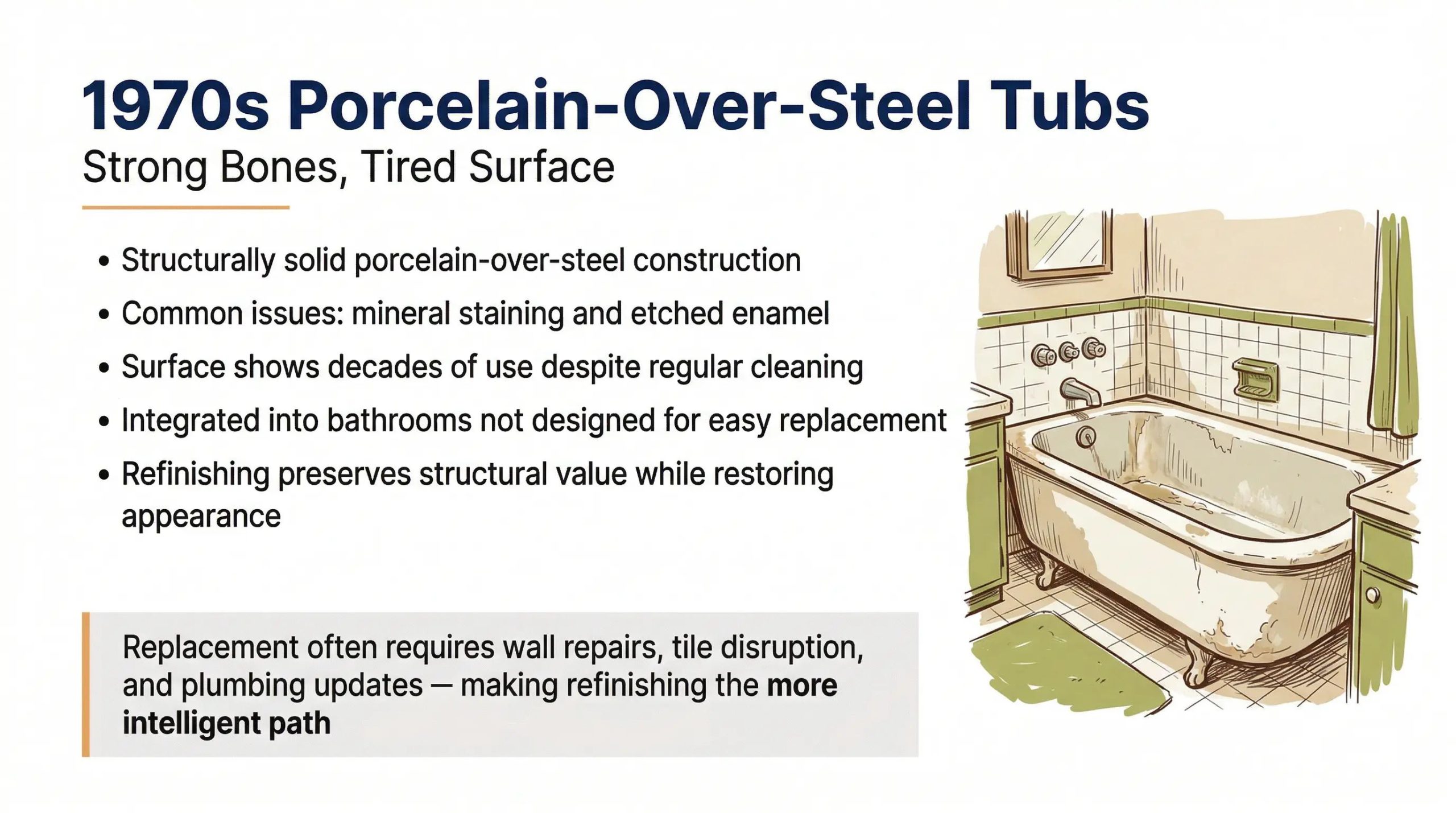
1970s La Costa homes: original tubs with strong bones and tired surfaces
In some of La Costa’s older homes, the original tub may still be in place. These are often porcelain-over-steel or similarly durable fixtures built to last, even if the surface no longer looks good. After decades of use, homeowners usually see mineral staining, dullness, etched enamel, surface roughness, and the familiar “I can clean it forever, and it still looks old” problem.
The reason refinishing works so well in this category is that the tub often still has structural value. The issue is not that the fixture is worthless. The issue is that time, water exposure, and cleaning have worn down the finish. Replacement can be more invasive than expected because these bathrooms were not necessarily built with today’s easy-swap assumptions in mind. Once demolition begins, the project can spill into wall repairs, tile disruption, plumbing updates, and a much larger budget.
For many 1970s La Costa homes, refinishing is the smarter path because it preserves what still works while restoring what no longer looks good.
1980s La Costa homes: the soaking-tub era
If there is one fixture type that feels unmistakably La Costa, it is the oversized 1980s soaking tub. This era embraced spacious primary bathrooms, larger tub decks, and luxury bathing features that made sense in upscale suburban design at the time. Many of those tubs are still in use today because they fit the room, feel substantial, and would be painful to replace.
But 1980s tubs age in recognizable ways. Fidel often sees surface crazing, ring staining, dullness from years of cleaning, failed caulk or grout lines at transitions, and finish degradation that makes a once-impressive tub feel dated. Jetted versions can add their own maintenance complications, but even non-jetted soaking tubs present the same core decision: do you demolish an architecturally integrated fixture, or do you restore it?
In La Costa, refinishing is often the better answer. A restored soaking tub can dramatically improve the bathroom without destroying surrounding finishes. Because these tubs are so visually dominant, the cosmetic payoff is also unusually strong.
1990s La Costa homes: fiberglass and acrylic units hitting their age wall
By the 1990s, more homes in La Costa and the surrounding 92009 area were using fiberglass and acrylic tubs, reflecting newer production patterns and changing bathroom design priorities. These fixtures are now old enough to show the classic refinishing-cycle wear pattern: yellowing, etched surfaces, fading gloss, floor wear, and a finish that seems to attract residue no matter how often the homeowner cleans.
This is often the easiest refinishing conversation in La Costa because the tub is usually still functional, but the appearance is clearly dragging down the bathroom. Homeowners are not dealing with sentimental value or a major design statement. They are dealing with a visible aging problem that is making the room feel older than it should.
When these tubs are structurally sound, refinishing often gives them the clean second life they need without the cost of replacement.
Why replacement is often more painful in La Costa than homeowners think
La Costa bathrooms tend to punish simplistic replacement thinking. What looks like “just changing the tub” can quickly become a much larger project because the fixture may be tiled in, deck-mounted, oversized, or tied to surrounding finishes that are difficult to match. Even when the homeowner is financially able to replace it, that does not mean replacement is the smart move.
The more integrated the fixture is, the stronger the case for refinishing becomes. This is especially true when the homeowner still likes the size, depth, and layout of the tub, and the real complaint is simply that it looks worn or dated.
How Fidel evaluates a La Costa tub
In La Costa, the first question is always: What era is this bathroom from? That usually reveals the likely material, the difficulty of replacement, and the type of failure pattern present. From there, the assessment focuses on whether the issue is cosmetic or structural.

Common questions include:
- Is the tub porcelain, fiberglass, acrylic, or a specialty soaking unit?
- Is the surface worn, or is the fixture physically compromised?
- Would replacement require tile demolition or layout disruption?
- Is the homeowner trying to preserve the original design logic of the bathroom?
- Is the goal daily-use improvement, resale presentation, or long-term restoration?
That kind of material-specific, era-specific thinking is what separates a useful refinishing recommendation from a generic sales pitch.
Which La Costa homes are the strongest candidates for refinishing?
The best candidates are usually:
- 1970s homes with structurally sound original tubs and finish deterioration
- 1980s homes with oversized soaking tubs that would be expensive or destructive to replace
- 1990s homes with aging fiberglass or acrylic units that have become visibly dated
- Pre-sale homes where the tub is the bathroom’s obvious visual weakness
- Homes not undergoing a full remodel, where surface restoration can deliver the biggest visual improvement per dollar spent
When refinishing may not be enough
If the tub has structural cracks, severe instability, major plumbing failure, or if the homeowner is already redesigning the entire bathroom, replacement may still be appropriate. But in La Costa, the mistake is often assuming replacement is the premium choice by default. In reality, the premium choice is the one that preserves value, improves appearance, and avoids unnecessary disruption. Very often, that is refinishing.
The bottom line on La Costa bathtub refinishing
If you own a home in La Costa, the right tub solution depends largely on the age and type of your fixture. Older porcelain tubs, 1980s soaking tubs, and 1990s fiberglass units each fail differently and have different restoration potential. That is why the best La Costa bathtub refinishing advice is neighborhood-specific, era-specific, and based on how these homes were actually built.
If your tub is worn but you suspect replacement could become a much bigger project than it sounds, a local refinishing assessment is the right next step. FG Tub and Tile’s Carlsbad bathtub refinishing page is the place to start if you want a practical opinion on whether your La Costa fixture is a good candidate for restoration.
continue reading
Related Posts
Bathtub Refinishing Ramona A Neighborhood-by-Neighborhood Guide for Village Homes, Country
Guest House Bathtub Refinishing in Ramona Keep Secondary Bathrooms Guest-Ready
Bathtub Refinishing in Ramona Rebuild Homes This is why post