
Refinishing vs. Replacing Your La Mesa Bathtub Cost Calculation
When La Mesa homeowners start thinking about a worn, stained, or outdated bathtub, the first question is usually simple: Should I refinish it or replace it? The answer sounds like a straightforward price comparison, but in East County homes, it rarely stays that simple for long. In newer bathrooms, replacing a tub may be relatively predictable. In older La Mesa homes, especially those with original tilework, older plumbing, and pre-1980 construction details, replacement can become a larger, more expensive project than homeowners expect.
That is why bathtub refinishing vs. replacement in La Mesa is not just a national cost question. It is a local housing stock question. At FG Tub and Tile, Fidel has seen the pattern repeatedly in East County: a homeowner begins with the idea of changing one tub and quickly realizes that demolition, surrounding damage, plumbing exposure, and scheduling delays can transform the budget. For many La Mesa homes, refinishing is not just cheaper. It is the option that avoids turning a manageable update into a partial bathroom remodel.

The Short Answer for La Mesa Homeowners
If your existing tub is structurally sound and the main problems are cosmetic, refinishing is usually the better financial decision. That includes issues like staining, dullness, outdated color, roughness, etching, and surface wear. General cost data support that conclusion. Angi reports a national range for bathtub refinishing of $337 to $631, with an average of $483, while a complete bathtub replacement averages about $5,700 and can climb much higher depending on the scope. In other words, refinishing often costs a fraction of the cost of replacement before the La Mesa-specific complications even begin.
| Option | Typical Cost Context | Best For | Main Risk |
|---|---|---|---|
| Refinishing | Often far below replacement; national benchmarks average around $483. | Solid tubs with cosmetic wear, outdated color, or surface damage | Not appropriate for severe structural failure |
| Replacement | National averages are much higher and can escalate with demolition and repairs. | Tubs with structural failure, movement, or major installation problems | Hidden labor, tile loss, plumbing surprises, and project expansion |
Why This Comparison Is Different in La Mesa
La Mesa is a city of established neighborhoods, long-held homes, and older bathrooms. The city’s housing and planning materials reflect that mature residential character, while Census data shows homeowners are protecting a high-value housing asset rather than casually replacing fixtures in low-stakes properties. In practical terms, that means homeowners are often less interested in tearing out usable fixtures and more interested in improving what they already have.
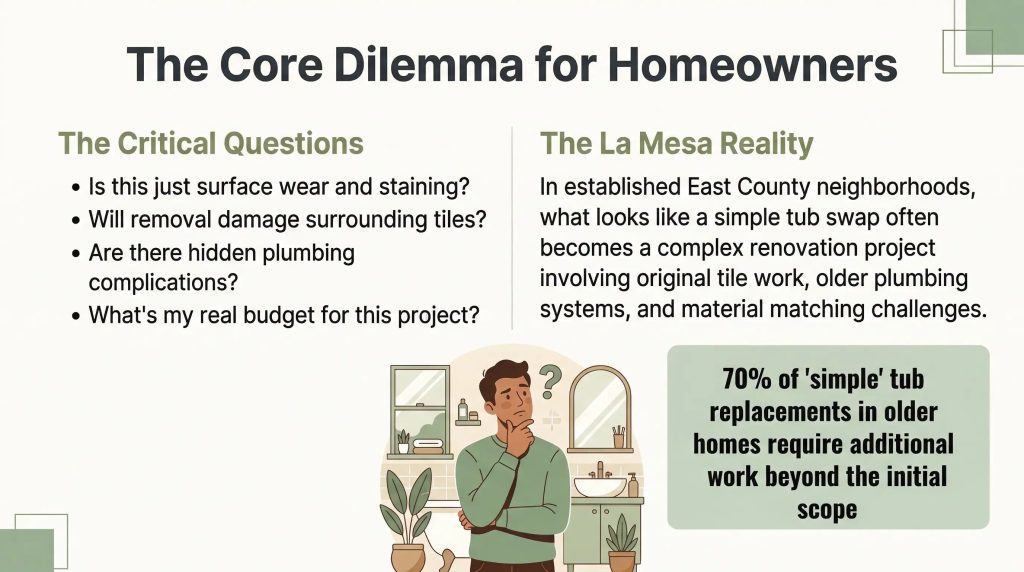
That context matters because older bathrooms are more interconnected than many people realize. Fidel’s field experience in East County homes is that replacement in older La Mesa properties often affects far more than the tub itself. Once demolition starts, homeowners may lose surrounding tile, expose older plumbing, discover subfloor or wall issues, and face material-matching problems that did not exist when the project was just a “tub swap.” This is especially true in homes where the bathroom was built as a durable, integrated assembly rather than a modern plug-and-play installation.
The True Cost of Refinishing in La Mesa
Refinishing is fundamentally a surface-restoration decision. When the tub body is still stable, the process restores appearance without removing the fixture from the room. That is its real financial power. Instead of paying for demolition, haul-away, new fixture purchase, plumbing reconnection, finish repairs, and schedule disruption, homeowners are paying for expert preparation, necessary repairs, coating application, curing, and finish restoration.
For La Mesa homeowners, the most common refinishing candidates are original porcelain tubs with stains or discoloration, older tubs dulled by harsh cleaners, and fixtures that simply make the bathroom look older than it should. Ferguson’s guidance on old porcelain surfaces reinforces that those tubs often suffer from dullness, scratches, etching, and surface wear due to abrasive cleaning and long-term mineral exposure. Those are refinishing problems, not automatic replacement problems.
What refinishing usually solves well
Refinishing is often a strong fit when the bathtub has one or more of the following conditions:
- Outdated original colors, such as harvest gold, avocado, pink, or blue
- Mineral staining or a surface that never looks fully clean
- Dullness from years of abrasive cleaning
- Soap-scum buildup caused by a roughened finish
- A failed prior coating or DIY tub paint job
- Minor chips or surface wear that can be repaired during preparation
The True Cost of Replacement in La Mesa
Replacement is where the headline number often misleads homeowners. Someone may price the tub itself and assume that is the project. In reality, the new unit is only one line item. National benchmarks already show replacement as dramatically more expensive than refinishing. But La Mesa adds a second layer of cost pressure: older homes can be less predictable once the existing bathtub is removed.
From Fidel’s East County project experience, replacement in older homes often triggers labor and material issues that do not show up in the first quote. The existing tile may need to be broken to remove the old tub. Surrounding finishes may not be salvageable. Plumbing may need updating once exposed. Nonstandard openings or older framing realities may complicate installation. Even when the homeowner intended to replace “just the tub,” the job can become part demolition, part repair, and part bathroom refresh. That is where the true La Mesa cost calculation changes.
| Replacement Cost Layer | Why It Matters in Older La Mesa Homes |
|---|---|
| Demolition | Removing an older tub often affects tile, wall finishes, and surrounding surfaces. |
| Plumbing exposure | Older homes may reveal piping or connection conditions that need attention once opened. |
| Material matching | Original tile, trim, and finish materials may be difficult or impossible to match cleanly. |
| Layout constraints | Custom or older bathroom dimensions can limit modern replacement options. |
| Project expansion | A tub replacement can become a broader bathroom renovation than the homeowner intended. |
When Refinishing Usually Wins the Math
In La Mesa, refinishing usually makes the most sense when the homeowner’s real objective is visual restoration rather than redesign. If you want the bathroom to look cleaner, brighter, more current, and more cared for without opening walls or replacing the room around the tub, refinishing is usually the better investment. This is especially true in postwar homes, Village-adjacent older neighborhoods, and houses where the fixture is original but still durable.
It also wins when the tub is unusual or deeply integrated into the bathroom design. A solid original fixture can be a valuable asset if it still fits the space properly. Replacing it may add cost without delivering any practical benefit beyond what refinishing would have achieved visually.
When Replacement Really Does Make More Sense
There are situations where replacement is the right call, and a trustworthy refinishing contractor should say so. If the tub flexes under weight, has major structural cracks, leaks from the body of the tub, or is tied to deeper installation failure, replacement may be the better long-term solution. Likewise, if the homeowner is already planning a full bathroom remodel with tile replacement, plumbing updates, and layout changes, the math may shift toward replacement because the broader demolition is happening anyway.
The key point is that replacement should be driven by structural need or a full-remodel strategy, not by cosmetic frustration alone. A stained or dated tub can look terrible and still be a perfectly good candidate for refinishing. That distinction saves La Mesa homeowners significant money when it is identified correctly.
Why Older La Mesa Tubs Are Often Better Candidates Than Homeowners Think
One of the biggest misconceptions is that age automatically means replacement. In reality, many older tubs were built from durable materials and simply need surface restoration. Ferguson’s guidance notes that old porcelain finishes can become dull and stain-prone over time, especially with harsh cleaners and hard-water exposure. That kind of wear looks severe, but it often lives at the finish level rather than the structural level.
Fiberglass and other later-era tubs can also remain candidates for refinishing if the issues are surface-related. Todd’s Bathtubs identifies common fiberglass problems, such as scratches, gelcoat erosion, discoloration, and staining, and explains that professional refinishing can restore many of these surfaces through proper preparation, repair, coating, and curing. The lesson for homeowners is simple: do not confuse surface failure with total fixture failure until someone qualified evaluates it.
A More Honest Way to Compare the Two Options
If you are comparing refinishing and replacement in La Mesa, the most useful question is not, “Which one is cheaper on paper?” It is, “What project am I actually starting?” If you choose refinishing, you are usually starting a surface-restoration job with limited disruption. If you choose replacement in an older East County home, you may be starting a demolition-and-repair project whether you intended to or not.
That is the true cost calculation for La Mesa homeowners: not just the price of the tub, but the total chain reaction your decision creates.
Frequently Asked Questions About Bathtub Refinishing vs. Replacement in La Mesa
Is bathtub refinishing cheaper than replacing a tub in La Mesa?
Usually, yes. General benchmark data shows refinishing costs far less than replacement, and older La Mesa homes can make replacement even more expensive once demolition and repairs are factored in.
Does an old tub always need to be replaced?
No. Older tubs often need surface restoration rather than removal. A worn finish, staining, or outdated color does not automatically mean the fixture is beyond saving.
When should I replace instead of refinish?
Replacement is more appropriate when the tub has structural failure, major cracking, persistent movement, or when a full bathroom remodel is already planned.
Why can replacement get expensive in older homes?
In older East County homes, removing the tub can affect tile, expose older plumbing, create material-matching problems, and expand the project beyond the bathtub itself.
Should I verify a contractor before booking either kind of work?
Yes. California’s CSLB specifically advises consumers to verify contractor information before hiring or signing a contract.

Bottom Line: In Many La Mesa Homes, Refinishing Is the Smarter Financial Decision
For many La Mesa homeowners, refinishing wins because it solves the actual problem without creating a larger one. If the tub is solid and the issue is cosmetic wear, outdated color, staining, or surface damage, refinishing usually delivers a better cost outcome. Replacement becomes the better option when the fixture is structurally failing or the homeowner is already committed to a broader remodel.
If you are weighing those two options and want a realistic opinion based on the type of tubs found in East County homes, FG Tub and Tile can help. Fidel understands the difference between a tub that needs restoration and a tub that truly needs removal. Before you turn a tired bathtub into a demolition project, get a professional assessment first.
continue reading
Related Posts
Bathtub Refinishing Ramona A Neighborhood-by-Neighborhood Guide for Village Homes, Country
Guest House Bathtub Refinishing in Ramona Keep Secondary Bathrooms Guest-Ready
Bathtub Refinishing in Ramona Rebuild Homes This is why post