
Fiberglass vs. Acrylic vs. Porcelain vs. Cast Iron Bathtub Refinishing
Which Material Gets the Best Results?
If you are searching for fiberglass bathtub refinishing in San Diego, there is a good chance you are also asking a bigger question: Does tub material affect how well refinishing works? The answer is yes. Not every bathtub material behaves the same way. Some surfaces are lighter and more flexible. Others are heavier, more stable, and more forgiving over the long term. Some materials are especially common in certain types of San Diego housing, so the material question is often tied directly to the home’s age, neighborhood, and style.
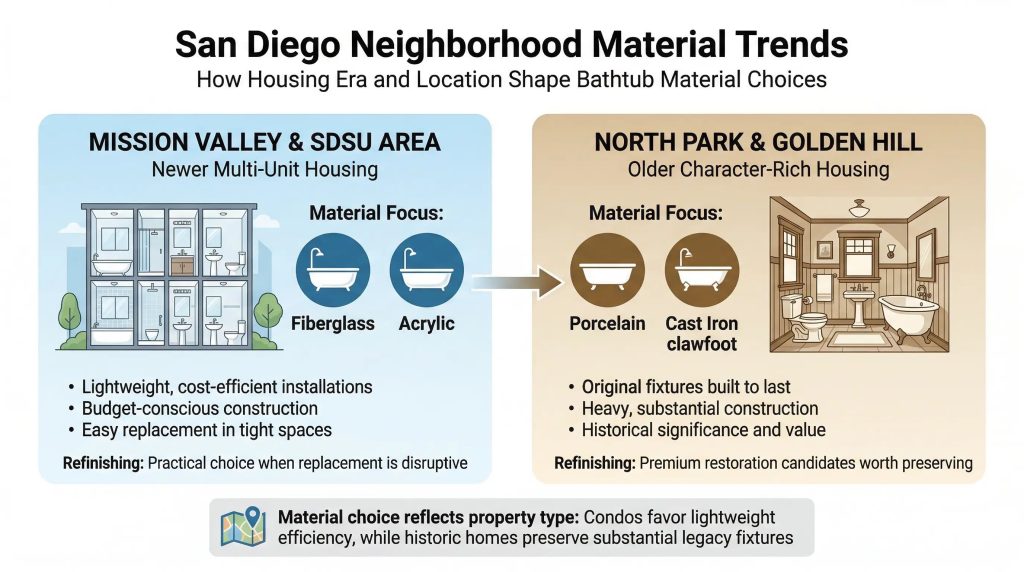
That is why material-specific knowledge matters. A homeowner with a fiberglass tub in a Mission Valley condo does not necessarily have the same refinishing considerations as someone with a cast-iron clawfoot tub in an older North Park or Golden Hill home. The surface under the coating changes the preparation approach, the repair strategy, and the long-term expectations for the finished result.
FG Tub and Tile presents itself as a San Diego refinishing specialist that handles bathtub refinishing as a detailed process involving cleaning, surface preparation, and durable coating application, and its homepage explicitly frames refinishing as a cost-effective way to restore appearance and extend fixture life. That professional approach matters even more when you are working across multiple tub materials, because each one has different strengths and limitations.
This guide compares the four bathtub materials homeowners most often ask about: fiberglass, acrylic, porcelain, and cast iron. It explains what each surface is, how it responds to refinishing, where the best results usually happen, and what San Diego homeowners should realistically expect.
Quick Answer: Which Tub Material Gets the Best Refinishing Results?
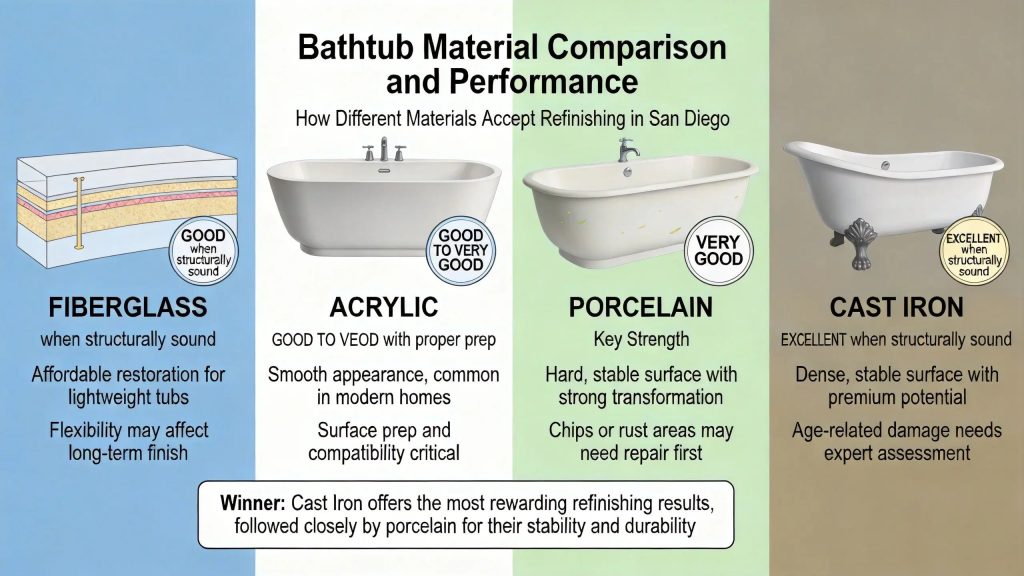
| Material | How Well It Typically Accepts Refinishing | Main Strength | Main Caution |
|---|---|---|---|
| Fiberglass | Good when structurally sound | Affordable way to restore a worn lightweight tub | Flexing can affect long-term finish performance |
| Acrylic | Good to very good with proper prep | Smooth appearance and common modern use | Surface prep and product compatibility are critical |
| Porcelain | Very good | Hard, stable surface and strong visual transformation | Chips or rust-related areas may need repair first |
| Cast iron | Excellent when the tub is still structurally sound | Dense, stable surface with premium restoration potential | Weight and age-related damage require an experienced assessment |
In general, cast iron and porcelain tubs often offer the most rewarding refinishing candidates because they tend to be stable, substantial fixtures worth saving. Acrylic can also produce strong results when properly prepared. Fiberglass can absolutely be refinished, but it usually requires more realistic expectations, as the tub itself may flex more with use.
Fiberglass Bathtub Refinishing in San Diego
Fiberglass tubs are among the most common bathtubs in budget-conscious and mid-range housing because they are lightweight and relatively affordable. They are often found in apartment stock, condos, and bathrooms built for cost efficiency rather than long-term heavy-duty performance. National bathtub material guides consistently describe fiberglass as one of the lighter, more economical materials, but also as more vulnerable to scratching, fading, and flexing over time.
That matters in refinishing. A fiberglass tub is often an excellent candidate for refinishing if the shell is still structurally sound and the main issues are cosmetic, such as staining, dullness, discoloration, or minor surface wear. The professional goal is to achieve a renewed finish on a properly prepared base. But because fiberglass is not as rigid as cast iron or porcelain, the long-term performance of the finish depends in part on whether the tub flexes under body weight or has hidden weak spots.
For San Diego homeowners, fiberglass is especially relevant in condo and apartment-heavy areas, including portions of Mission Valley and rental-heavy housing near SDSU, where lighter, mass-installed tubs became common in later housing stock. In those situations, refinishing can be very attractive because replacement is often disruptive, expensive, and harder to manage in tighter multi-unit settings.
Best-case verdict: fiberglass bathtub refinishing in San Diego can work very well when the tub is intact, stable under load, and primarily experiencing cosmetic wear. It is one of the most practical refinishing scenarios when the homeowner wants to avoid replacement in a condo or rental property.
Acrylic Tub Refinishing: Similar to Fiberglass, but Not Identical
Acrylic tubs are often grouped together with fiberglass because both are lighter-weight materials common in modern bathrooms. But they are not the same. Acrylic tubs generally have a more durable finished surface than bare fiberglass units and are popular because they balance affordability, design flexibility, and easier installation with that of very heavy tubs.
From a refinishing standpoint, acrylic can produce very good results, but only when preparation is handled correctly. The surface must be cleaned and conditioned properly so the new coating can bond as intended. This is not a material where shortcuts help. If prep is weak, adhesion problems become far more likely. That is one reason professional refinishing matters so much on acrylic surfaces.
In San Diego homes, acrylic tubs are common in newer remodels and replacement installations, as homeowners have moved away from older steel or cast-iron tubs. These tubs often become candidates for refinishing once the shine fades or the surface shows visible wear, even though the tub itself is still serviceable.
Best-case verdict: acrylic refinishing, refinishes well when the tub remains structurally sound, and the work is performed with the correct material-specific prep. It usually delivers a cleaner final result than homeowners expect, but it should not be treated like a generic paint surface.
Porcelain Tub Refinishing in San Diego
When homeowners search for porcelain tub refinishing in San Diego, they are usually dealing with a harder, heavier-feeling tub surface that may already have lasted through decades of use. Consumer references to bathtub materials commonly describe porcelain-coated tubs, often over steel or cast iron, as durable and familiar but vulnerable to chipping if struck hard enough.
Porcelain is often an excellent candidate for refinishing because the underlying tub is typically more stable than lightweight modern alternatives. If the main issues are discoloration, worn gloss, cosmetic chips, outdated color, or rust-related blemishes that have not progressed too far, refinishing can restore the appearance without tearing out a perfectly usable fixture.
This category is especially relevant in older San Diego homes where original bathroom fixtures are still in place. Homeowners who want to preserve bathroom character while modernizing the look often find that refinishing a porcelain tub gives them the best of both worlds.
Best-case verdict: Porcelain tubs often refinish very well and can deliver one of the strongest appearance upgrades in the category, especially when the tub remains solid and the damage is largely cosmetic.
Cast Iron Tub Refinishing: Often the Best Restoration Candidate
Cast iron tub refinishing is often where refinishing shines the most. Cast iron tubs are heavy, dense, and worth saving when they are still structurally sound. They were built to last, and in many cases, the real problem is not the tub itself. The problem is that the finish has aged, dulled, stained, chipped, or become visually outdated.
That is why cast iron is so often considered the premium restoration case. Because the tub body itself is extremely substantial, refinishing is a way to preserve its quality, which would be expensive and impractical to replace today. The Spruce notes that enamel-coated cast iron tubs can often be identified with a magnet, and broader material guides consistently describe cast iron as one of the most durable and longest-lasting bathtub materials available.
In San Diego, this matters in older neighborhoods with historic or character-rich housing stock. North Park and Golden Hill, along with other older residential areas, include homes from earlier development eras where heavier legacy fixtures are more likely to survive. San Diego’s historic context materials for older residential development show that these neighborhoods feature long-established housing patterns dating back to earlier phases of city growth. When those homes still have original or long-standing tubs, refinishing a cast-iron unit is often much smarter than replacing it.
Best-case verdict: If the tub is truly cast iron and the structure remains sound, refinishing often produces the most satisfying and highest-value results of any material category.
How Prep Differs by Material
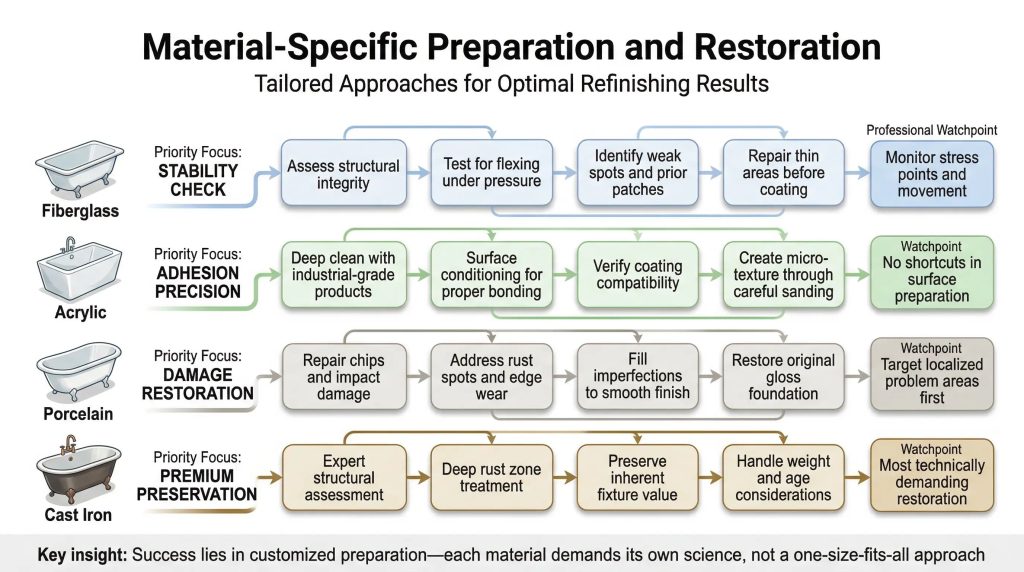
Material differences matter most in preparation. Although every professional refinishing job requires cleaning, repair work where needed, and coating application, the underlying tub material affects how sensitive the surface is to movement, chip repair, adhesion, and long-term expectations.
| Material | Prep Priority | What Professionals Watch Closely |
|---|---|---|
| Fiberglass | Stability and surface wear | Flexing, stress points, prior patching, thin areas |
| Acrylic | Adhesion-sensitive prep | Surface conditioning and coating compatibility |
| Porcelain | Chip, rust, and gloss restoration | Localized damage, edge wear, impact chips |
| Cast iron | Restoration of aged premium fixture | Rust zones, old damage, and preserving structural value |
FG Tub and Tile’s description of refinishing as a careful process built on cleaning, surface preparation, and the application of durable coatings aligns directly with this material-specific reality. Professional refinishing is not one-size-fits-all. The process has to match the tub.
Which Material Gives the Longest-Lasting Refinished Result?
As a general rule, the more stable the tub body, the more favorable the long-term refinishing conditions tend to be. That is one reason cast iron and many porcelain tubs often perform so well as candidates for refinishing. Their stability supports the new finish. Fiberglass and some acrylic tubs can still look excellent after refinishing, but they may be more dependent on how much the tub moves, how well it was maintained, and whether the base structure is still strong.
This does not mean fiberglass is a bad candidate. It simply means expectations should be calibrated correctly. A professionally refinished fiberglass tub can still be a very smart investment, especially when the alternative is replacement in a condo, rental unit, or budget-conscious remodel. But if the question is which material usually offers the best restoration platform, the answer often points toward cast iron and porcelain.
Why Material Matters So Much in San Diego Homes
San Diego’s housing variety makes this topic unusually practical. Older homes in neighborhoods such as North Park and Golden Hill are more likely to contain long-standing heavy fixtures worth preserving. Later apartment and condo stock near SDSU, Mission Valley, and other multi-unit corridors more commonly includes lighter fiberglass or acrylic tubs, where replacement can be logistically frustrating and financially inefficient. That means the tub material is not just a technical detail. It is often tied directly to the local housing era and property type.
For homeowners, that matters because the right refinishing advice should account for both the material and the property context. The same answer does not apply equally to a clawfoot cast iron tub in a character home and a fiberglass tub-shower combo in a rental unit.
Final Answer: Which Material Gets the Best Results?
If you want the short answer, here it is: cast iron usually offers the best refinishing platform; porcelain is often close behind; acrylic can perform very well with proper prep; and fiberglass can still be a strong candidate when the tub is stable, and the issues are cosmetic.
For San Diego homeowners specifically, fiberglass bathtub refinishing remains one of the most practical options because many condos, apartments, and later-era bathrooms use lightweight tubs that are too expensive or disruptive to replace. But if you are lucky enough to own an old cast-iron or porcelain tub with good bones, refinishing may deliver the most dramatic and highest-value transformation of all.
FAQ
Can fiberglass bathtubs be refinished in San Diego?
Yes. Fiberglass tubs can often be refinished successfully when the shell is structurally sound and the main issues are cosmetic, such as staining, fading, or surface wear.
Does porcelain tub refinishing last longer than fiberglass?
In many cases, porcelain tubs offer a more stable refinishing surface than fiberglass, which can support strong long-term results when the tub is in otherwise good condition.
Is cast iron the best tub material to refinish?
Often, yes. Cast iron tubs are often the most rewarding candidates for refinishing because they are dense, stable, and usually worth preserving.
Can acrylic tubs be professionally refinished?
Yes. Acrylic tubs can be refinished very well, but proper preparation and coating compatibility are essential for the finish to bond properly.
Why are fiberglass tubs so common in San Diego condos and rentals?
Fiberglass tubs are lightweight and cost-effective, which makes them common in later multi-unit housing and budget-conscious bathroom installations.
Should I replace or refinish my old porcelain or cast-iron tub?
If the tub is structurally sound and the problems are mainly cosmetic, refinishing is often the better value because it preserves a heavy, high-quality fixture without the disruption of replacement.
continue reading
Related Posts
Bathtub Refinishing Ramona A Neighborhood-by-Neighborhood Guide for Village Homes, Country
Guest House Bathtub Refinishing in Ramona Keep Secondary Bathrooms Guest-Ready
Bathtub Refinishing in Ramona Rebuild Homes This is why post