
DIY Bathtub Refinishing Kits vs. Hiring a Pro in San Diego
What the Kits Don’t Tell You
If you are comparing DIY bathtub refinishing vs professional bathtub refinishing, you are asking the right question at exactly the right stage. Many homeowners do not start with, “Who should I hire?” They start with, “Can I just buy a kit and do this myself?” On the surface, that seems reasonable. DIY bathtub refinishing kits are marketed as fast, affordable, and good enough for a cosmetic refresh. For a homeowner looking at a dull, stained, or outdated tub, that promise is appealing.
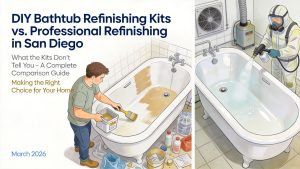
But the real decision is not whether a kit can change a tub’s color for a short period. The real decision is whether a kit can deliver the same adhesion, finish quality, durability, safety, and long-term value as a professional refinishing job. In most cases, it cannot.
FG Tub and Tile positions professional refinishing as a less intrusive, cost-effective alternative to replacement, relying on thorough cleaning, detailed surface preparation, and the application of a durable coating that withstands daily use. That description alone highlights the gap between a true refinishing system and the average consumer kit. Most kits promise a visible improvement. Professional refinishing is designed to restore a usable, stable surface.
This article explains what DIY kits can sometimes do well, where they usually fail, what the true cost of DIY can become, and why California safety and ventilation rules matter more than most homeowners realize.
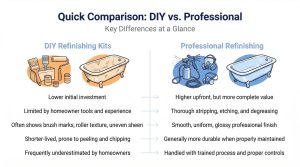
Quick Answer: DIY vs. Professional
| Category | DIY Kit | Professional Refinishing |
|---|---|---|
| Upfront cost | Usually lower at first | Higher upfront, but more complete |
| Surface preparation | Limited by homeowner tools and experience | Professional prep is far more thorough |
| Finish quality | Often, brush marks, roller texture, or uneven sheen | Smoother, more uniform professional finish |
| Durability | Often shorter-lived and more failure-prone | Generally, more durable when properly maintained |
| Ventilation and safety | Frequently underestimated by homeowners | Handled with a trained process and proper controls |
| Best use case | Minor cosmetic touch-up in limited situations | Full bathtub refinishing and long-term appearance upgrade |
If your goal is a full-surface restoration that looks professionally redone, the comparison usually favors hiring a professional. If your goal is only a tiny cosmetic patch and you accept the limitations, a DIY product may have a narrow use case.
What DIY Kits Actually Do Well
To be fair, DIY kits are not useless. They can make sense in very limited situations. For example, a homeowner may use a touch-up product on a small chip in a secondary bath, a low-priority rental, or a tub that is already near the end of its life. In those situations, the homeowner may simply want a temporary improvement in appearance rather than a true resurfacing result.
That is the key distinction: temporary cosmetic improvement is not the same as full refinishing. A small chip fill or color touch-up is one thing. Restoring an entire tub so the surface bonds properly, cures correctly, and holds up under daily use is something else entirely.
San Diego homeowners should be careful not to confuse “the tub looks a little better today” with “the tub was refinished correctly.” Those are very different outcomes.
Where DIY Bathtub Refinishing Kits Usually Fail
The biggest problem with DIY kits is not that they never work. They are often asked to do a job they were never truly built to do at a professional level.
Full bathtub refinishing depends on several things that homeowners usually underestimate:
- Surface preparation. Soap residue, body oils, old coatings, mineral deposits, and hidden contamination all interfere with adhesion. If the prep is incomplete, the finish is compromised before it even starts.
- Chemical bonding. A coating is only as good as its bond to the prepared surface. This is where many DIY failures begin.
- Application quality. Consumer kits often lead to roller texture, streaks, drips, or weak visual uniformity, especially on large curved surfaces like tubs.
- Cure and durability. A tub is a wet, high-use environment. A coating that looks acceptable on day one may begin to fail under repeated exposure to water, heat, and cleaning products.
FG Tub and Tile emphasizes that professional refinishing is a delicate process that requires cleaning, preparation, and the application of a durable coating. That is a professional standard, not a casual weekend-paint standard.
This is also why many professionals end up fixing failed DIY attempts. Once a kit peels, softens, discolors, or bonds unevenly, the homeowner often pays not only for the professional tub refinishing but also for stripping or correcting the failed coating first.
The True Cost of DIY Is Usually Higher Than the Box Price
One reason DIY kits are attractive is obvious: the sticker price looks low. But homeowners comparing DIY bathtub refinishing vs professional bathtub refinishing should think in terms of total project cost, not just initial product cost.
| Potential DIY Cost Component | Why It Matters |
|---|---|
| Kit purchase | The advertised entry price is only the beginning |
| Prep supplies and masking materials | Cleaning agents, abrasives, tape, plastic, and fillers add up quickly |
| Protective equipment | Respiratory and ventilation needs are often under-budgeted |
| Tool upgrades | Better rollers, sprayers, or repair materials may be needed for acceptable results |
| Time cost | Surface prep, application, cure time, and cleanup can consume multiple days |
| Failure cost | If the coating fails, homeowners may face a second attempt or a professional strip-and-refinish job |
That is the part the packaging rarely explains. A homeowner may think they are saving money, only to end up spending more after buying extra supplies, living with disappointing results, and ultimately hiring a professional anyway. In practice, the cheapest-looking option often becomes the most expensive option once rework is involved.
What the Kits Don’t Tell You About Safety and Ventilation
This is where the comparison becomes more serious than it appears at first. Spray-applied refinishing materials and coating systems can involve chemicals that require meaningful ventilation and respiratory protection. California’s Department of Public Health warns that exposure to isocyanates can cause asthma and other serious health effects, and emphasizes that these chemicals are used in products such as polyurethane and paint systems.
California workplace safety rules go even further on spray operations. Title 8, Section 5153 states that spray coating operations should be confined to properly designed and adequately ventilated spray booths or spray rooms whenever practicable, that mechanical ventilation must remain in operation during spraying, and that respiratory protection is required in certain operator positions.
That matters for one simple reason: a residential bathroom is not a professional spray booth. Many homeowners read “open a window” and assume that it is equivalent to proper ventilation. It is not. Bathrooms are enclosed spaces, and tubs are often refinished in areas with limited airflow, especially in condos and interior bathrooms.
California also regulates VOC-related emissions through state air-quality programs. The California Air Resources Board explains that its consumer products program helps reduce volatile organic compounds and toxic air contaminants associated with consumer products. Even without delving deeply into product chemistry, that broader context reinforces the point that coatings and solvents are not to be treated casually.
San Diego-Specific Considerations Homeowners Often Miss
Local context also matters. In San Diego, many homeowners live in condos, attached housing, and HOA-regulated communities where odor, ventilation, access, and neighboring units can all complicate DIY work. Even when a small cosmetic project does not require a building permit, broader bathroom alterations, plumbing changes, or remodel-related work often trigger additional requirements. The City of San Diego notes that repairs alone may not require permits, while broader improvements and certain building or plumbing work do.
That distinction is important. A professional refinishing project is often less invasive than replacement, which is one reason it appeals to condo owners and homeowners in tightly regulated communities. In places like Carlsbad, Coronado, and other HOA-heavy neighborhoods, minimizing demolition, hauling, plumbing disruption, and neighbor complaints can make professional refinishing far more practical than a messy DIY experiment or full replacement project.
For multi-unit buildings, ventilation concerns are also more sensitive. Odors and overspray issues do not affect only the person doing the project. They may affect adjoining units, shared hallways, and HOA compliance expectations. That is another reason professionals are generally better positioned to manage the work responsibly.
Why Professional Results Usually Look Better and Last Longer
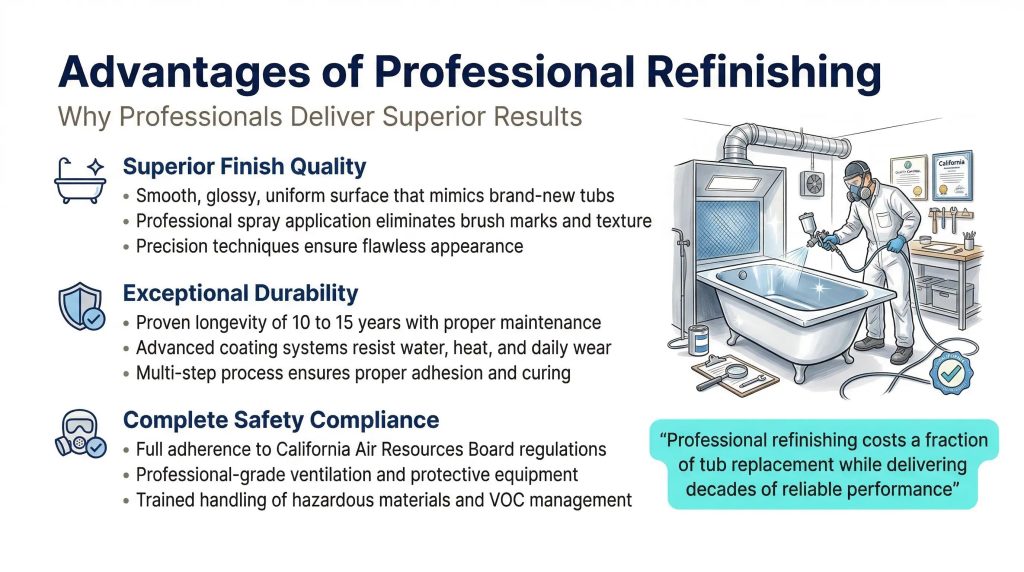
The visual gap between DIY and professional work is usually obvious in person. Professional refinishing is not just about applying a coating. It is about achieving a finish that looks smooth, uniform, and intentional. The difference shows up in gloss consistency, edge treatment, adhesion, and the tub’s performance after repeated daily use.
FG Tub and Tile describes its finish as smooth and glossy and frames refinishing as a durable, less intrusive alternative to replacement. That is exactly what most homeowners are actually trying to buy. They are not buying a weekend project. They are buying an outcome: a bathtub that looks substantially renewed without the disruption of tearing it out.
That is also why professional refinishing tends to convert better once homeowners understand the full comparison. The homeowner who starts by shopping for a kit is often not committed to DIY. They are simply trying to avoid unnecessary cost. Once they see the risks, limitations, and likely rework path, the professional option often becomes the more rational choice.
When DIY Might Make Sense
There are still limited cases where DIY is reasonable. If the project is a tiny chip touch-up, the tub is not a long-term priority, the homeowner accepts a non-professional appearance, and there is no expectation of full refinishing performance, a small repair product may be acceptable.
But if the homeowner wants any of the following, professional refinishing is usually the better choice:
- A full-tub color or appearance transformation
- Better long-term durability
- A smoother finish with fewer visible defects
- A safer process with more controlled application conditions
- Less chance of paying twice after a failed attempt
Bottom Line for San Diego Homeowners
For most full-surface projects, DIY bathtub refinishing vs professional bathtub refinishing is not really a close comparison. DIY kits may have a limited role in minor cosmetic touch-ups, but they generally fall short in surface preparation, finish quality, durability, and safety. Once you factor in the hidden cost of supplies, time, protective gear, risk of failure, and the possibility of paying for corrective work later, the “cheap” option often stops looking cheap.
For San Diego homeowners, that gap is even more important because local housing types, HOA conditions, attached living arrangements, and California safety expectations all raise the stakes. If the goal is a properly restored bathtub surface, professional refinishing is usually the smarter and more economical path.
FAQ
Are DIY bathtub refinishing kits worth it?
They can be worth it for very small cosmetic touch-ups where the homeowner accepts limited durability and non-professional results. They are usually not the best solution for full bathtub refinishing.
Why does professional bathtub refinishing last longer than DIY?
Professional work typically involves better surface preparation, stronger coating systems, and more controlled application methods, all of which improve adhesion and durability.
Is DIY bathtub refinishing dangerous?
It can involve meaningful chemical and ventilation risks. California public health and workplace safety sources emphasize the importance of controlling exposure to coating-related chemicals and ensuring adequate ventilation in spray operations.
Can I refinish a tub in a condo by myself?
You may be able to perform minor cosmetic work, but condos introduce additional concerns involving ventilation, odors, neighbors, HOA rules, and building access. Those issues often make professional refinishing the safer path.
Is professional bathtub refinishing cheaper than replacement?
In many cases, yes. Professional refinishing is often a less intrusive and more cost-effective alternative to full replacement, especially when the tub is structurally sound.
What is the biggest mistake homeowners make with DIY tub kits?
The biggest mistake is underestimating the requirements for preparation, ventilation, and adhesion. Many failed jobs start with the assumption that a tub can be refinished like an ordinary paint project.
continue reading
Related Posts
Bathtub Refinishing Ramona A Neighborhood-by-Neighborhood Guide for Village Homes, Country
Guest House Bathtub Refinishing in Ramona Keep Secondary Bathrooms Guest-Ready
Bathtub Refinishing in Ramona Rebuild Homes This is why post