
7 Signs Your Bathtub Needs Refinishing (Not Replacing)
A San Diego Pro’s Checklist
If you are trying to figure out when to refinish a bathtub in San Diego, the most important question is not whether the tub looks old. It is whether the problems you are seeing are cosmetic and refinishable, or whether the tub has reached a condition that requires repair or replacement first.
For many San Diego homeowners, the decision point shows up before they ever search for a contractor. The tub is starting to look harder to clean. The finish feels rough. Stains come back no matter what you use. Small chips begin to spread. Grout around the tub starts holding moisture. Or the entire bathroom suddenly looks dated because the tub color belongs to another decade. These are the moments when homeowners start wondering whether they should act now or wait.
That is exactly where refinishing can make sense. FG Tub and Tile describes refinishing as a less intrusive, more affordable alternative to replacement, restoring fixtures to a like-new appearance while extending their lifespan. The company also explains that professional refinishing depends on careful cleaning, surface preparation, and application of a durable coating that can withstand daily use.
This article is built around the real-life symptom question homeowners ask: Is this tub still a refinishing candidate, or is it too far gone? Below is a practical, San Diego-specific checklist that explains which signs usually point to refinishing, which mean “do it soon,” and which suggest the tub or surrounding area should be repaired first.
Quick Verdict Table: Refinishable, Urgent, or Repair First?
| Symptom | Typical Meaning | Best Verdict |
|---|---|---|
| Peeling or flaking finish | The old coating is failing | Usually refinishable; do it before deterioration spreads |
| Persistent staining that will not clean off | Surface wear, mineral buildup, or embedded discoloration | Often refinishable |
| Rough, chalky, or etched surface | The protective finish has worn down | Refinish soon |
| Grout failure or moisture around tub edges | Water intrusion risk near the tub surround | Repair the moisture issue first, then refinish if appropriate |
| Yellowing or age-related discoloration | The finish is dated or oxidized | Usually refinishable |
| Chips or cracks | May be cosmetic or structural, depending on depth and movement | Minor damage is often repairable; structural issues need evaluation first |
| Outdated color or style is hurting resale appeal | Appearance problem rather than failure | Strong refinishing candidate |
This table gives the short version. The sections below explain how to interpret each sign more accurately in a real San Diego home.
1. The Finish Is Peeling or Flaking
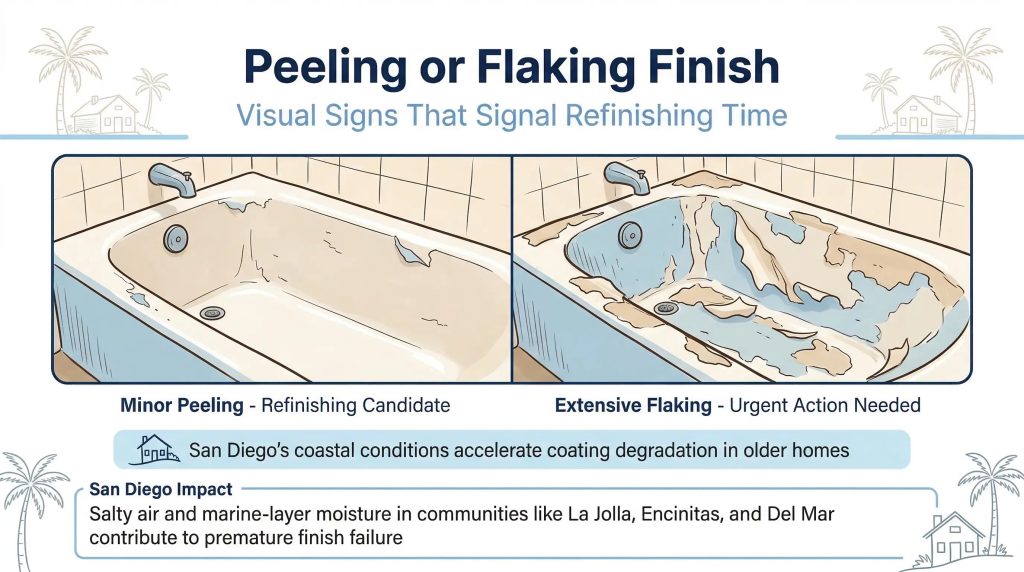
Peeling or flaking is one of the clearest signs that a tub needs professional attention. In many cases, what is failing is not the tub itself but the surface coating on top of it. Once the finish starts separating, the tub usually becomes harder to clean, more visually uneven, and more vulnerable to further deterioration.
This symptom is often still refinishable, but it should not be ignored. The longer a failing finish is left in place, the more prep work may be needed later. That matters because refinishing depends on proper adhesion. If sections are loose, brittle, or inconsistent, the surface must be professionally prepared before a durable new finish can be applied.
San Diego verdict: In many older homes across San Diego County, a peeling tub surface is still a refinishing project, not a replacement project. The smart move is to address it before moisture, grime, and further coating failure make the prep more involved.
2. The Tub Has Stains That Never Really Come Clean
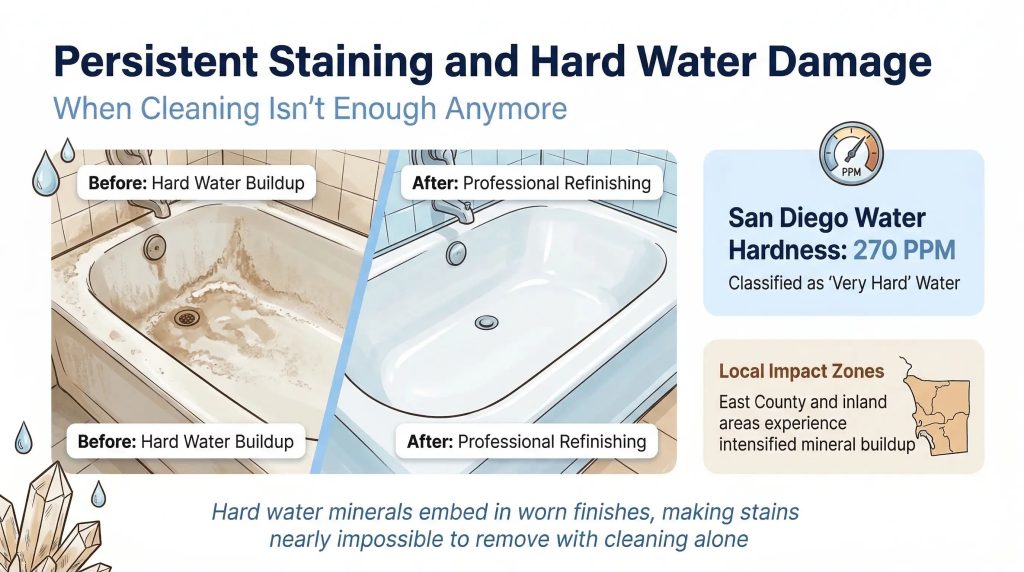
Persistent staining is another classic sign of refinishing. If the tub still looks dingy or discolored after repeated cleaning, the issue may no longer be surface dirt. It may be wear, etching, mineral staining, or discoloration embedded in the tired finish itself.
This is especially relevant in San Diego because hard water is a well-known local issue. Regional plumbing and water-quality sources note that San Diego water commonly contains calcium and magnesium that leave visible scale and mineral buildup on bathroom fixtures over time. In practical terms, that means a tub may look permanently dirty even when the homeowner is cleaning it regularly.
For East County homes in particular, hard water deposits can make a bathtub look older faster. Once the finish becomes worn enough, staining tends to cling more aggressively. At that stage, refinishing is often the cleaner long-term solution than repeatedly scrubbing a deteriorated surface.
San Diego verdict: If staining will not come off and the tub’s structure is still sound, the tub is usually a good candidate for refinishing.
3. The Surface Feels Rough, Chalky, or Etched
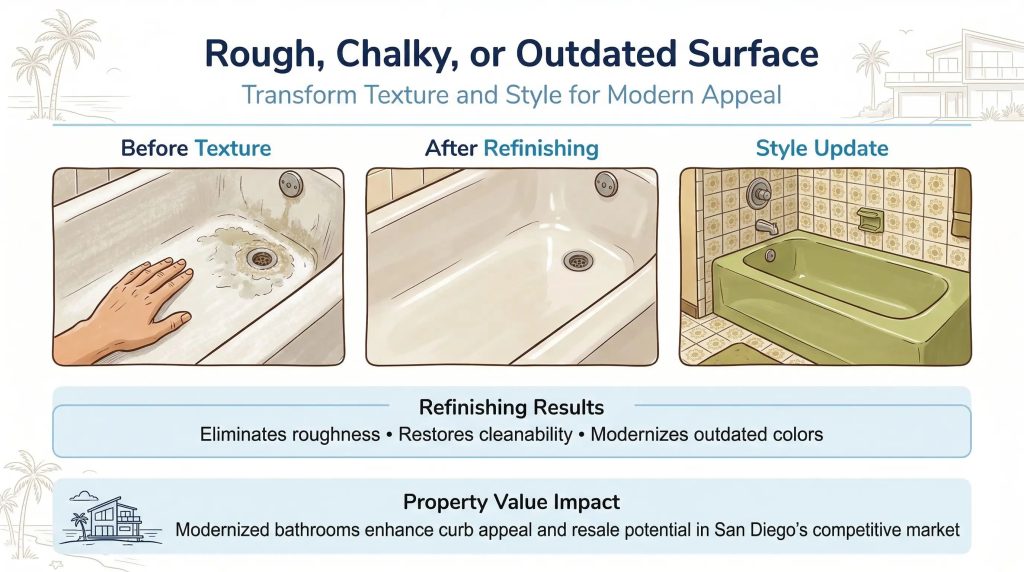
A bathtub should not feel abrasive, dull, or chalky under normal use. When it does, that often means the original finish has worn down. Once the protective surface is compromised, soap residue, mineral deposits, and everyday grime cling more easily. The tub may also lose the smooth, glossy look that made it easy to maintain in the first place.
FG Tub and Tile specifically describes its process as restoring a smooth and glossy finish that stands up to daily use. That tells you what the end goal of refinishing really is: not just making the tub look whiter, but restoring the usable surface condition homeowners want from a bathtub.
In beach communities and other coastal parts of San Diego County, older fixtures may also show accelerated wear because moisture and salty air can be harder on finishes over time. Even when the tub is not structurally damaged, the finish may simply be past its serviceable stage.
San Diego verdict: A rough or etched tub is usually in the “refinish soon” category. It is commonly repairable through refinishing, but waiting usually makes daily cleaning more frustrating.
4. Grout Around the Tub Is Failing or Holding Moisture
This is where homeowners need to be a little more careful. Grout failure around the tub does not necessarily mean the bathtub itself must be replaced, but it may indicate that the surrounding system is retaining moisture. If grout is cracked, separating, darkened, or repeatedly damp, you may have a moisture-management problem that should be addressed before cosmetic work proceeds.
That matters because mold growth is fundamentally a moisture problem. The CDC states that if mold is growing in a home, it is necessary to clean up the mold and fix the moisture source, and it emphasizes that mold grows where there is moisture. In bathrooms, that makes failed grout, leaking seams, and chronically damp transitions much more important than homeowners often realize.
This is particularly relevant in San Diego’s marine-influenced climate. Even though the region is not considered as humid as other coastal areas, bathrooms can still trap moisture, especially where ventilation is weak, and marine-layer conditions keep surfaces cooler and slower to dry.
San Diego verdict: If the tub is cosmetically worn but grout failure suggests water intrusion, fix the moisture issue first. After that, the tub may still be a very good candidate for refinishing.
5. The Tub Is Yellowed, Dull, or Discolored From Age
Not every worn bathtub is damaged. Some are simply old-looking. Years of use can leave a tub yellowed, faded, or visually tired, even if it still functions perfectly. This is one of the strongest situations for refinishing, because the homeowner is solving an appearance problem without opening the door to unnecessary demolition.
FG Tub and Tile positions refinishing as a cost-effective way to improve appearance, extend fixture life, and enhance property value. That is especially relevant for San Diego homeowners preparing to sell, update a dated bathroom, or improve a property without stepping into the cost of full replacement work.
If the tub’s bones are sound and the main issue is age-related appearance, refinishing is often the most practical option.
San Diego verdict: Usually refinishable, and often one of the easiest yes-decisions in the entire category.
6. There Are Chips or Cracks — but You Need to Know Which Kind
This is the symptom homeowners misunderstand most. A small chip is not the same thing as a structural crack. A cosmetic edge nick, a shallow surface chip, or minor isolated damage may still be repairable as part of a refinishing project. A deeper crack, flexing area, or active movement issue is different. That may point to substrate instability, tub failure, or a repair-first situation.
The practical rule is simple. Small cosmetic damage often supports refinishing. Structural damage requires diagnosis first. That is why an experienced refinisher’s judgment matters. Surface restoration works best when the tub beneath the finish is still stable.
For San Diego homeowners, this distinction matters in everything from older post-war homes with long-used bathrooms to rental properties that have seen years of tenant wear. Two tubs can both have “cracks,” yet only one may actually need replacement. The other may just need targeted repair and refinishing.
San Diego verdict: Minor chips are commonly refinishable. Structural cracks or flex-related damage should be evaluated and repaired first, if possible.
7. The Color or Style Makes the Whole Bathroom Look Outdated
Sometimes the tub is not failing at all. It just drags the room down. Beige, pink, almond, harvest gold, or other dated finishes can make an otherwise clean bathroom feel older than it is. For many homeowners, this becomes a resale or pride-of-ownership issue long before it becomes a functional one.
This is where refinishing can deliver disproportionate value. A color update can change how the entire bathroom reads without forcing the homeowner into demo, haul-away, plumbing changes, or tile disruption. In a market like San Diego, where cosmetic upgrades often need to make financial sense quickly, that equation matters.
San Diego verdict: If the tub is structurally sound and the problem is dated style, refinishing is often the obvious choice.
A San Diego-Specific Checklist Before You Wait Too Long
Because local conditions affect how surfaces age, San Diego homeowners should pay special attention to three patterns.
- Hard water deposits in East County and other mineral-heavy areas. Mineral buildup can make a tub look permanently dirty and can accelerate the “hard to clean” phase of surface wear.
- Coastal wear in beach communities. Older fixtures near the coast may show more oxidation, finish fatigue, and stubborn surface wear over time.
- Moisture retention around grout and caulk. If the bathroom remains damp, any grout failure should be addressed promptly before it becomes a moisture issue that supports mold growth.
If you recognize one or more of these patterns, the right next step is not guessing. It is getting the tub and its surrounding condition evaluated before the problem becomes more expensive than necessary.
When Not to Refinish First
Although many problem tubs are still refinishing candidates, there are situations where refinishing should not be the first move. These include active leaks, persistent movement of the tub base, major structural cracking, or moisture damage in the surround that has not yet been corrected. In those cases, the issue is not just the finish. It is the system around it.
That is why the best refinishing decisions are diagnostic, not just cosmetic. A professional should be able to distinguish between a tired surface and a failing structure.
FAQ
When should I refinish my bathtub in San Diego?
You should consider refinishing when the tub is structurally sound but showing peeling finish, permanent staining, roughness, age-related discoloration, or outdated appearance.
Can hard water in San Diego make my tub look worse than it really is?
Yes. Hard water minerals can create visible buildup and staining on bathroom fixtures, which may make a still-usable tub look older or dirtier than it actually is.
Does peeling the bathtub finish mean I need a replacement?
Not necessarily. Peeling often means the surface coating is failing, and many tubs with peeling finishes are still good refinishing candidates if the underlying structure is sound.
What if the grout around my tub is failing, too?
If grout failure is allowing moisture to linger or penetrate, that problem should be fixed first. Moisture issues can support mold growth and should not be ignored.
Are chips and cracks always a sign that I need a new tub?
No. Small cosmetic chips may be repairable and compatible with refinishing. Larger or structural cracks should be evaluated first to determine whether repair or replacement is more appropriate.
Is refinishing worth it for an outdated tub color?
Yes, often. If the tub is structurally sound, refinishing can modernize the bathroom without the disruption and expense of replacement.
Final Verdict
If you are wondering when to refinish a bathtub in San Diego, the best answer is this: refinish when the tub is still structurally sound but the finish is clearly no longer doing its job. Peeling, stubborn stains, a rough texture, age-related discoloration, and outdated color are all strong signals that refinishing is needed. Grout-related moisture issues and structural cracks are the main situations that need repair, first judgment.
For many San Diego homeowners, waiting too long is what turns a simple refinishing candidate into a more complicated project. If the tub still has good bones, refinishing is often the smarter move before deterioration spreads further. That is the exact value proposition FG Tub and Tile highlights on its website: a more affordable, less intrusive way to restore the fixture’s appearance and extend its life.
continue reading
Related Posts
Bathtub Refinishing Ramona A Neighborhood-by-Neighborhood Guide for Village Homes, Country
Guest House Bathtub Refinishing in Ramona Keep Secondary Bathrooms Guest-Ready
Bathtub Refinishing in Ramona Rebuild Homes This is why post