
Bathtub Refinishing vs. Replacement vs. Liner
Side-by-Side Cost and Outcome Comparison for San Diego Homeowners
If you are comparing bathtub refinishing vs. replacement in San Diego, the short answer is: refinishing is usually the best value when your tub is structurally sound but worn, stained, chipped, or outdated. Replacement makes more sense when the tub is badly damaged, leaking, or the bathroom layout is changing. A bathtub liner sits in the middle, but for many homeowners, it costs far more than refinishing while often delivering a shorter lifespan. For that reason, refinishing is usually the obvious first option to consider before you commit to demolition.
That distinction matters even more in San Diego, where bathroom upgrades can quickly become expensive once demolition, disposal, plumbing adjustments, finish repairs, and permit-related scope enter the picture. On the official FG Tub and Tile website, the company positions refinishing as more affordable than replacement, states that most projects are completed in just a few hours, and notes that homeowners can typically resume using the bathroom within 24 hours. Independent cost data points in the same direction. Angi reports average bathtub refinishing costs around $490, compared with average bathtub replacement costs around $5,700.
This guide walks through the three main options side by side so San Diego homeowners can make the right decision for their budget, timeline, and long-term plans.
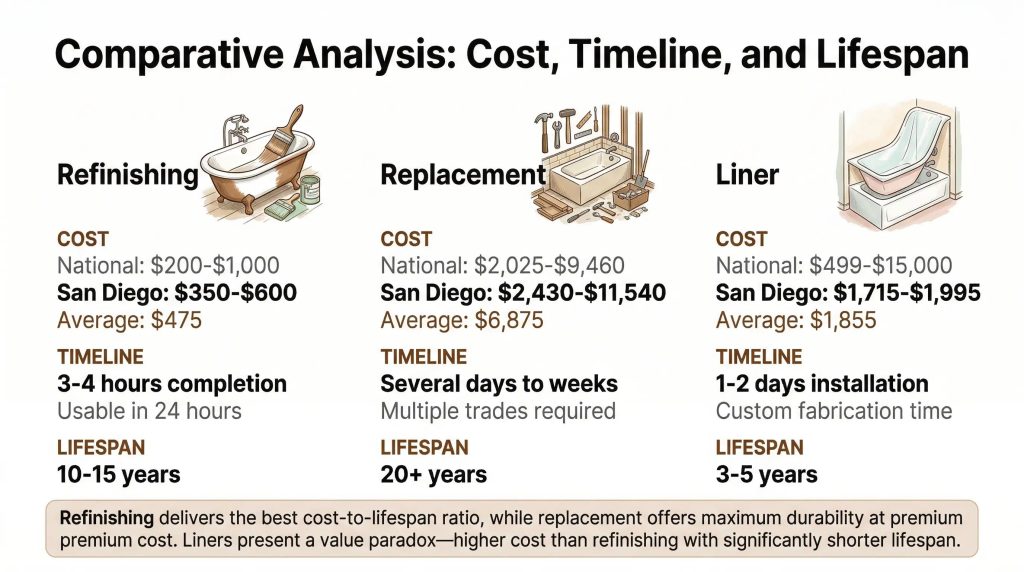
Quick Comparison: Refinishing vs. Replacement vs. Liner
| Option | Typical Cost Range | Average Cost | Project Timeline | Typical Lifespan | Demolition Required? | Best For |
|---|---|---|---|---|---|---|
| Bathtub Refinishing | $200-$1,000 | $490 | Usually 3-4 hours, usable in about 24 hours | Often 10-15 years | No | Structurally sound tubs with cosmetic wear |
| Bathtub Replacement | $2,025-$9,460 | $5,729 | Often, several days to multiple weeks, depending on the scope | New tub lifecycle | Yes | Failed, leaking, or layout-change projects |
| Bathtub Liner | $499-$15,000 | $6,394 | Usually faster than full replacement | About 3-5 years | No major demo | Homeowners seeking a cover-over solution |
The headline comparison is straightforward. Refinishing usually costs a fraction of the cost of replacement and, according to Angi, can last 10 to 15 years. Liners avoid demolition, but their average cost is actually higher than bath tub refinishing, and their expected lifespan is often shorter. That is why many decision-stage homeowners in San Diego start with one question: if the tub itself is still solid, why pay for demolition first?
What Bathtub Refinishing Actually Means
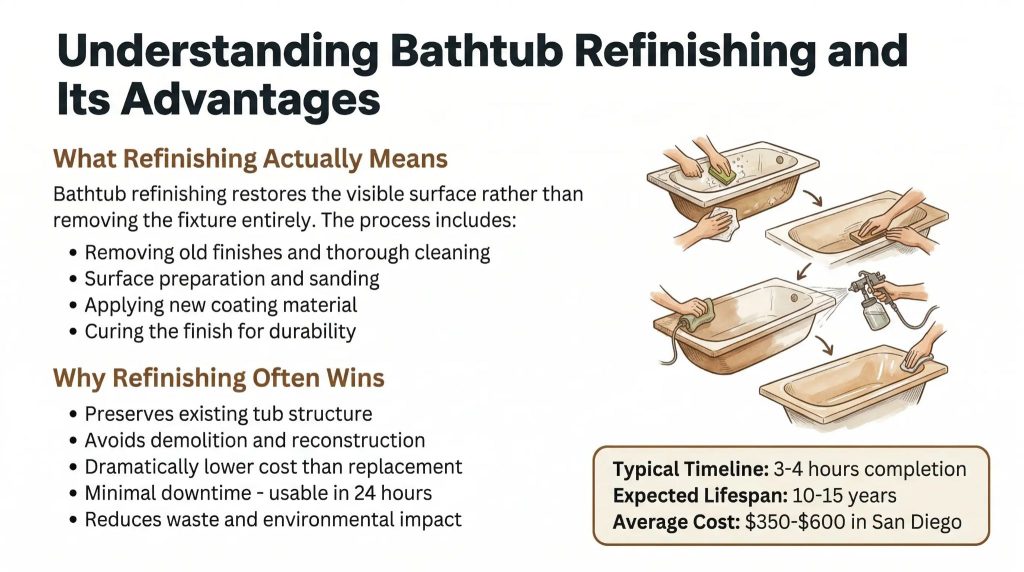
Bathtub refinishing, also called reglazing or resurfacing, restores the visible surface of the tub rather than removing the fixture entirely. According to FG Tub and Tile, the process includes removing old finishes, preparing the surface, applying a new coating, and curing the finish to achieve a smooth, glossy result.
For many San Diego homes, this is the most sensible option because the problem is visual rather than structural. A tub may be stained, discolored, chipped, rough to the touch, or simply stuck in an outdated color scheme, but still remain serviceable underneath. In those cases, refinishing solves the appearance problem without triggering the disruption and expense that often come with replacement.
When Bathtub Replacement Makes Sense
Replacement is the right call when the tub is no longer a good refinishing candidate or when the bathroom renovation is larger than the tub itself. If a bathtub is leaking, severely cracked, flexing, failing at the plumbing connections, or part of a complete layout change, replacement may be necessary.
That said, replacement costs rarely extend to the new tub alone. Angi notes that homeowners may also need to budget for removal and disposal, subfloor preparation, surrounds, faucets, electrical upgrades, water damage repairs, and permits. In San Diego, official city guidance states that a plumbing permit is required for the alteration, addition, or replacement of a plumbing system or any portion of it, while only certain minor installations qualify for a simpler no-plan permit process. In practical terms, once a project moves beyond surface restoration and into plumbing or building scope, complexity rises quickly.
Where Bathtub Liners Fit In
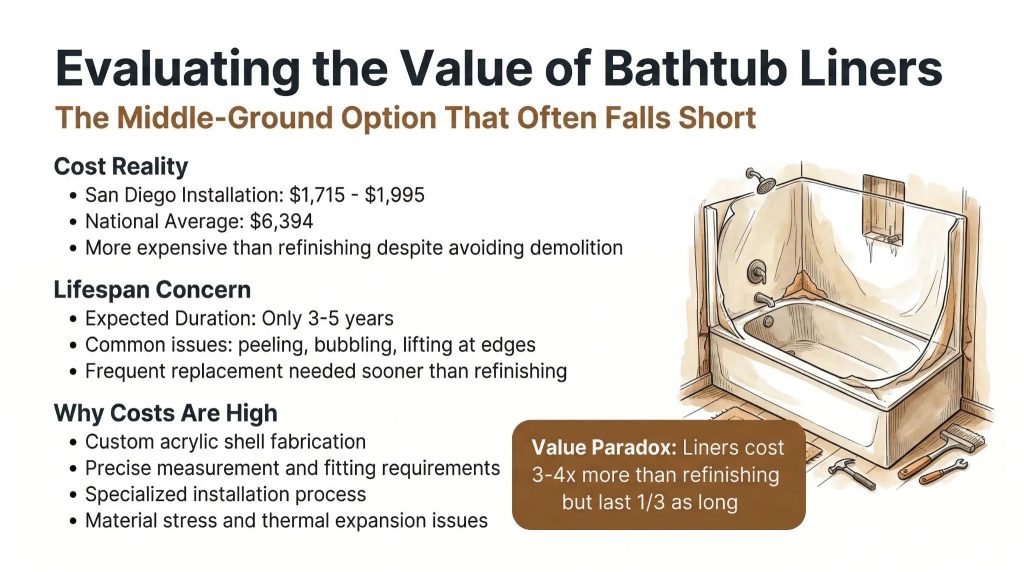
A bathtub liner is essentially a custom acrylic shell installed over the existing tub. On paper, that sounds like a middle-ground solution: less demolition than replacement, but a newer-looking tub than a worn original surface. The problem is that liners often disappoint in value when compared directly with refinishing.
Angi reports an average cost of $6,394 for tub or shower liner installation, with a wide range of $499 to $15,000, and an approximate lifespan of only 3 to 5 years. By contrast, the same source reports that refinishing typically costs $350 to $650 and lasts 10 to 15 years. For homeowners evaluating return on investment, that comparison is hard to ignore.
Why Refinishing Often Wins in San Diego
San Diego homeowners are not just comparing three bathroom options in a vacuum. They are also comparing labor costs, project disruption, property values, and the inconvenience of taking a working bathroom offline. In that environment, refinishing often becomes the strongest option for five main reasons.
- It preserves the existing tub. If the original tub still has good structural integrity, refinishing lets you keep it instead of ripping it out.
- It avoids demolition. No tile tear-out, disposal hauling, or major reconstruction is typically required.
- It is dramatically less expensive. National benchmark data consistently show refinishing costing a fraction of full replacement.
- It minimizes downtime. FG Tub and Tile states that most projects are completed in a few hours and are usable again within about 24 hours.
- It reduces waste. Keeping the original tub in place prevents unnecessary disposal and supports a more resource-efficient upgrade path.
For a homeowner in North Park, Mission Valley, Clairemont, or La Mesa, those advantages can be especially meaningful when the bathroom is functional but dated. The less you disturb the room, the lower the chance that a cosmetic problem becomes a full remodeling project.
The Decision Factors That Matter Most
1. Cost
If budget is the leading factor, refinishing usually wins decisively. Angi places the average refinishing cost at about $490, while replacement averages roughly $5,729. Even when refinishing reaches the upper end of the national range, it is still usually far below the total cost of replacement once demolition and repair work are included.
2. Timeline and Disruption
Refinishing is often the least disruptive option. FG Tub and Tile says the process usually takes 3 to 4 hours, with bathroom use restored in about 24 hours. Replacement, by contrast, can involve multiple trades, schedule coordination, debris removal, and possible repair of surrounding finishes. Liners are faster than full replacement, but they still involve fabrication and installation steps that do not beat the speed-to-value of a professional refinish in many cases.
3. Lifespan
A quality refinishing job can deliver meaningful service life. Angi cites 10 to 15 years as a typical lifespan range for refinishing. Liners, by comparison, are estimated at around 3 to 5 years. Replacement gives you a brand-new fixture lifecycle, but that longer horizon only justifies the cost when the existing tub is genuinely beyond restoration, or the whole room is being reworked.
4. Appearance and Resale Impact
All three options can improve appearance, but they do so in different ways. Replacement delivers a new unit. Liners cover the old one. Refinishing restores what is already there. For many homes, a professionally refinished tub delivers the clean, bright, updated look homeowners want without the design compromises or edge details that sometimes make liners feel like an overlay instead of a full restoration.
5. Project Risk
The more work a bathroom project involves, the greater the opportunity for hidden costs. Replacement can expose water damage, subfloor issues, plumbing misalignment, or the need for finish repairs. Angi specifically notes that taking out an old tub can reveal water damage and trigger restoration costs. Refinishing usually keeps the project confined to the tub’s surface, which is one reason it remains attractive to homeowners who want predictable outcomes.
Which Option Is Best? A San Diego Scenario Guide
| Scenario | Best Option | Why |
|---|---|---|
| Your tub is ugly, stained, or chipped, but still solid | Refinishing | Solves the real problem without demolition |
| You are remodeling the full bathroom layout | Replacement | Best when plumbing or room configuration is changing |
| You want the lowest practical cost and fastest turnaround | Refinishing | Usually offers the strongest cost-to-outcome ratio |
| You want to cover the old tub without tearing it out | Liner or refinishing, usually refinishing first | Refinishing often delivers better value than a liner |
| The tub has structural failure, leaks, or major movement | Replacement | Surface restoration will not solve the underlying failure |
| You want to preserve an older cast-iron or original tub | Refinishing | Keeps the original fixture while restoring its appearance |
This is where experience matters. A professional evaluation can tell you whether the tub has “good bones” and is worth saving, or whether deeper failure makes replacement unavoidable. That judgment is often what separates a smart upgrade from an expensive overreaction.
How FG Tub and Tile Fits This Decision
For homeowners leaning toward refinishing, FG Tub and Tile is positioned around the exact benefits most comparison shoppers care about: lower cost than replacement, quick turnaround, preserved fixtures, reduced waste, and a durable, restored finish. The company also presents itself as a San Diego refinishing specialist with more than 40 years of experience, family ownership, BBB accreditation, and licensed technicians, all of which support an experience-based decision rather than a purely price-based one.
That experience matters in a comparison article because the right answer is not always “refinish no matter what.” The right answer is to refinish when the tub is a good candidate, replace when the tub or project demands it, and avoid paying liner-level money for a shorter-term outcome if refinishing would have solved the problem more effectively.
Our Practical Verdict for San Diego Homeowners
If your bathtub is structurally sound and the main issue is cosmetic wear, professional refinishing is usually the best first option to evaluate in San Diego. It is typically the least expensive, the least disruptive, and often the strongest value path. Replacement should be reserved for tubs with an underlying failure or for bathrooms already within the full renovation scope. Liners may appear convenient, but when average cost and lifespan are compared side by side, they often lose on value.
That does not mean every tub should be refinished. It means every homeowner should compare the three options honestly before assuming replacement is the default. In many bathrooms, especially where the tub itself is still solid, refinishing is the smarter move.
FAQ: Bathtub Refinishing vs Replacement in San Diego
Is bathtub refinishing cheaper than replacement in San Diego?
Yes. Independent national benchmarks put bathtub refinishing at around $490 on average, compared with roughly $5,700 for replacement, before factoring in the local labor and demolition realities that can push replacement even higher.
How long does bathtub refinishing last?
Professional refinishing can often last 10 to 15 years, depending on the tub’s condition, the quality of preparation, and maintenance.
Is a bathtub liner better than refinishing?
Not usually from a value perspective. A liner can hide surface wear without full demolition, but benchmark data show liners often cost much more than refinishing and last fewer years.
When should I replace my bathtub instead of refinishing it?
You should lean toward replacement when the tub has structural failure, leaking, major movement, severe damage beyond surface restoration, or when the bathroom layout and plumbing are already being changed.
Does a bathtub replacement require a permit in San Diego?
It can. The City of San Diego states that a plumbing permit is required for the alteration, addition, or replacement of a plumbing system or any portion of it, while certain minor installations may qualify for a simpler permit path.
Ready to Compare Your Own Tub?
If you are trying to decide between refinishing, replacing, or installing a liner, the most important first step is to determine whether your existing tub is still a strong candidate for refinishing. If it is, you may be able to avoid demolition, save thousands, and get a like-new finish without turning a bathroom upgrade into a full construction project. For San Diego homeowners exploring that option, FG Tub and Tile is a logical place to start the comparison because the company focuses specifically on the value drivers that matter most in this decision: cost, speed, durability, and preservation.
If you want a professional opinion on whether your tub should be refinished or replaced, contact FG Tub and Tile for an evaluation and quote.
continue reading
Related Posts
Bathtub Refinishing Ramona A Neighborhood-by-Neighborhood Guide for Village Homes, Country
Guest House Bathtub Refinishing in Ramona Keep Secondary Bathrooms Guest-Ready
Bathtub Refinishing in Ramona Rebuild Homes This is why post